Above Ground Pool Pump Guide for Colorado Owners
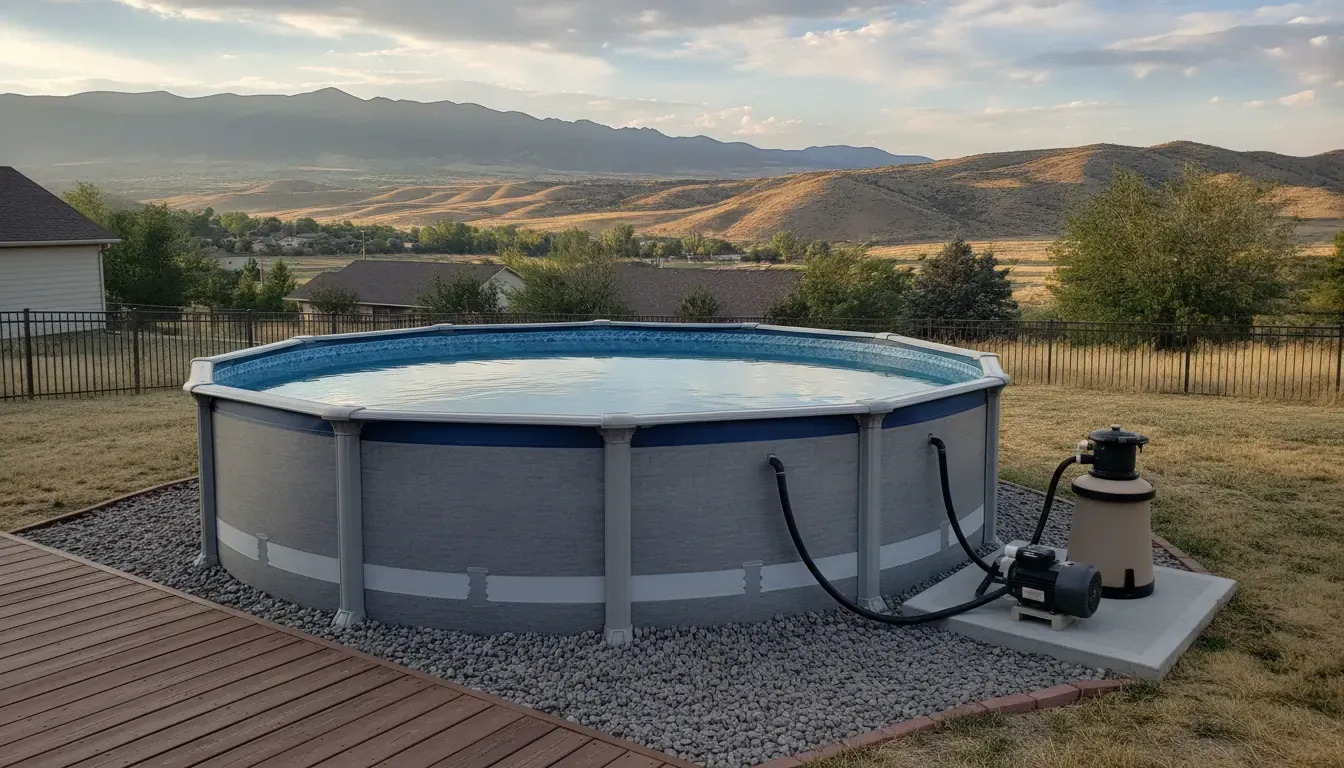
Choosing an above ground pool pump is not just a matter of picking the biggest motor on the shelf. The right setup must move enough water through the filter, match the pool's volume and plumbing, operate safely, and stand up to Colorado's dry summers and freezing weather. This guide explains how to size the pump, pair it with the filter, plan installation, and protect the equipment through the year.
Talk with Neptune Pools about pool equipment service.
Short answer: Start with pool volume, the turnover time you want, and the flow rate your filter can handle. Then account for plumbing resistance, the pump's operating curve, electrical requirements, and the way you will close or protect the pool in winter. A pump that is too small may not circulate and filter effectively. A pump that is too large can push water too quickly, waste energy, create excess pressure, or damage a filter that was not designed for that flow.
What an above ground pool pump does
The pump is the circulation heart of the pool system. It pulls water from the skimmer and, when present, a dedicated suction line. The pump then pushes that water through the filter and returns cleaner water to the pool through the return fitting. This circulation distributes treated water, carries debris to the filter, and helps prevent stagnant areas.
The pump does not sanitize the pool by itself. It also does not replace testing, chemical balancing, brushing, skimming, or filter cleaning. It creates the circulation needed for those parts of the system to work together.
Most above-ground pools use a compact pump and filter assembly. Some are sold as an integrated pump and filter system, while others use separate components connected with flexible hose or rigid plumbing. The system may sit below the pool waterline, near the waterline, or above it. That position affects priming, suction, and the type of pump required.
How to size an above ground pool pump
Pool volume is the best place to start. If you do not know the volume, use the manufacturer's capacity information or estimate it from the pool's shape and dimensions. For a round pool, a basic estimate is:
- Volume in gallons = diameter x diameter x average water depth x 5.9.
For a rectangular pool, a common estimate is:
- Volume in gallons = length x width x average water depth x 7.5.
These formulas are estimates. An oval pool, sloped floor, unusual wall shape, or water level that changes over the season can make the actual volume different. Use the pool or liner manufacturer's capacity when it is available.
Use turnover to estimate flow
Turnover is the time required to circulate a volume of water equal to the pool's capacity through the system once. It is a planning calculation, not a guarantee that every part of the pool receives identical circulation.
To estimate the flow needed for one turnover, divide gallons by minutes:
- Required gallons per minute = pool volume in gallons / desired turnover time in minutes.
For example, a 12,000-gallon pool would need about 25 gallons per minute for one eight-hour turnover. The same pool would need about 16.7 gallons per minute for one twelve-hour turnover. The calculation does not tell you to buy a pump advertised at that exact number. The pump must deliver that flow at the system's actual resistance, and the filter must be rated for the resulting flow.
Above-ground systems are often designed around smaller plumbing and compact filters than in-ground systems. A pump's maximum flow number, horsepower label, or marketing name does not show how it will perform after hose length, fittings, elevation, valves, and filter pressure are included.
Do not size by horsepower alone
Horsepower can be useful for comparing compatible equipment, but it is not a complete sizing method. Two pumps with the same horsepower can have different impeller designs, operating curves, electrical requirements, and flow at a given resistance.
When comparing models, look for the flow curve or performance chart. It should show how much water the pump moves at different levels of resistance. A qualified installer can compare that curve with the filter's maximum flow, the pool's plumbing, and the expected operating conditions.
A three-quarter-horsepower pump may be appropriate for one above-ground pool and a poor match for another. Pool volume, filter type, pipe size, hose routing, elevation, and the manufacturer's instructions matter more than a generic rule based only on motor size.
A practical sizing workflow
- Confirm the pool's water volume from the manufacturer or a careful estimate.
- Choose a reasonable turnover window based on the pool and operating plan.
- Calculate the approximate gallons per minute for that turnover.
- Check the filter's minimum and maximum flow guidance.
- Compare pump performance at the system's expected resistance, not at zero resistance.
- Confirm plumbing, controls, electrical requirements, and winter operating needs before purchasing.
How to match the pump to the pool filter
The filter and pump are a working pair. Water that moves through the filter too slowly may not provide the circulation you need. Water that moves too quickly can increase pressure, reduce filtration effectiveness, and make the filter harder to operate within its design range.
Check the filter's published flow rating before choosing a pump. The pump's expected operating flow should not exceed the filter's maximum rated flow. You should also confirm that the connections, hose diameter, adapters, valves, and return fitting are compatible.
| Filter type | Routine care | Key pump-matching point |
|---|---|---|
| Cartridge | Remove and clean the cartridge when pressure rises or flow falls, following the filter instructions. | Keep expected flow within the cartridge filter's rated range and avoid a pump that creates excessive pressure. |
| Sand | Backwash or rinse according to the filter instructions and water condition. | Confirm the pump can support the filter's required flow without exceeding its maximum rating. |
| DE | Backwash and recharge only as directed for the specific filter. | Use the filter's flow and pressure limits as the constraint, not the pump's maximum advertised output. |
| Integrated above-ground system | Clean or replace the specified cartridge or media and inspect the housing and connections. | Use the replacement pump or filter combination approved for that system instead of mixing unverified parts. |
Pressure is a useful operating signal, but it is not a universal target. Record the clean-filter pressure after the system is operating normally. A meaningful rise from that baseline can indicate a dirty filter, blocked return, closed valve, algae load, or another circulation issue. Follow the filter manufacturer's instructions before backwashing, cleaning, or replacing media.
Which pump type makes sense for an above-ground pool?
The best pump type depends on the pool system, available power, operating schedule, noise tolerance, and service needs. There is no single model that is right for every above-ground pool.
Single-speed pumps
A single-speed pump runs at one main speed. Its simpler controls can make it straightforward to operate, and it may be a practical replacement when the existing filter and plumbing were designed around that setup. The tradeoff is that the pump cannot slow down for quieter, lower-flow circulation.
Dual-speed pumps
A dual-speed pump can run at a lower speed for routine circulation and a higher speed for tasks that require more flow, depending on the model and system. It may need compatible controls and correct programming. Confirm that the filter operates properly at both speeds and that the installation instructions support the configuration.
Variable-speed pumps
A variable-speed pump can adjust its speed for different operating needs. Lower-speed circulation may be useful when the system can maintain adequate flow, while higher speed may be needed for priming or a specific water feature. The potential benefit depends on correct programming, filter compatibility, and actual run time. Variable-speed equipment is not automatically the right choice for every compact above-ground system.
When evaluating an upgrade, compare the complete system rather than the motor alone. Include the pump, filter, controls, plumbing adapters, electrical work, and the settings needed to keep water moving. Cost questions are separate from this guide's selection fundamentals, so review a qualified recommendation for your specific equipment instead of assuming that the newest or largest pump is the best value.
Ask about a maintenance plan that keeps pool circulation and filtration on schedule.
Installation considerations for above-ground pool pumps
A safe installation starts with the equipment label and the manufacturer's instructions. Confirm the required voltage, amperage, breaker, cord, plug, bonding, and grounding requirements before replacing a pump. Water and electricity are a dangerous combination. Electrical work, new circuits, bonding changes, and hardwired equipment should be handled by a qualified professional who can follow local requirements.
Set the equipment on a stable, level base that will not shift as the ground settles or becomes wet. Keep the motor and electrical connections protected from standing water. Leave enough room to remove the strainer lid, clean the basket, access the filter, and inspect the plumbing. Do not enclose the motor in a way that blocks ventilation.
Keep suction plumbing as short and direct as the system design allows. Unnecessary bends, restrictions, leaks, and undersized hose can reduce flow and make priming harder. Use the correct fittings and clamps for the pump and pool. Do not force a connection that does not match the manufacturer's specifications.
After installation, fill and prime the system according to the pump instructions. Never allow a pump to run dry. Check the lid seal, basket, unions, hose connections, return flow, pressure, and filter condition. Shut the system down if you see a leak, hear unusual grinding, smell overheated wiring, or notice that the pump loses prime repeatedly.
Routine care that protects pump and filtration performance
A good maintenance routine prevents many circulation problems before they become equipment failures. The exact schedule depends on the pool, weather, debris load, bather use, and filter type, but these checks are useful starting points.
- Keep the water level high enough for the skimmer to draw water without pulling air.
- Empty the skimmer and pump baskets before debris restricts flow.
- Check the pump lid and O-ring for damage, dirt, or a poor seal.
- Watch for air bubbles, foamy return water, loss of prime, or a sudden change in return flow.
- Clean the filter using the method approved for its cartridge, sand, or DE media.
- Record clean-filter pressure and investigate a meaningful rise instead of guessing.
- Keep chemical readings in the appropriate range for the pool and test water consistently.
- Inspect hoses, clamps, valves, unions, and exposed plumbing for leaks or brittleness.
Pool chemistry and circulation work together. Poor water balance can contribute to scale, corrosion, cloudy water, or filter loading. On the other hand, adding chemicals without fixing weak circulation can leave untreated areas and make the water harder to manage. Neptune Pools provides pool cleaning, equipment inspection, and chemical support for Denver Metro homeowners who want a consistent routine.
Colorado care for an above-ground pool pump
Colorado weather creates two different equipment priorities. Summer brings dry conditions, dust, debris, strong sun, and rapid weather changes. Fall and winter bring freezing temperatures, snow, wind, and the risk that water trapped in equipment or plumbing will expand.
Summer operation
During hot or windy periods, check water level more often. Evaporation can lower the water below the skimmer intake, while dust and pollen can load the filter faster. Keep the skimmer basket clear and watch for reduced return flow after storms. A clean filter and correct water level help the pump maintain prime.
Do not respond to cloudy water by increasing pump speed indefinitely. First check the basket, filter pressure, water level, chemical readings, and visible leaks. If the system still cannot maintain circulation, stop before the pump runs dry and arrange an inspection.
Freeze protection and winter shutdown
Water left inside a pump housing, filter, heater, valve, or plumbing line can freeze and expand. The safest winter approach depends on whether the pool stays open or is closed. An open pool needs a reliable plan for circulation during freezing weather, including protection against power loss. A closed pool needs the equipment and lines drained or blown out using the correct procedure for that system.
Do not assume that turning the pump on once will protect the equipment for the entire cold season. Confirm that freeze protection controls are active when the system uses them, and know what happens if power is interrupted. Keep the water level and skimmer condition appropriate for an operating system. For a closed pool, follow the equipment and cover instructions rather than improvising with a running pump.
Above-ground plumbing and exposed equipment can be especially vulnerable to wind and rapid temperature changes. A technician can identify low points where water remains trapped, inspect connections, and recommend a seasonal plan that fits the equipment. Neptune Pools provides pool closing, line blow-out, equipment shutdown, and freeze protection services in the Denver Metro area.
Get local help with pool supplies and seasonal chemical needs.
When should you repair or replace the pump?
Some circulation problems come from a clogged basket, dirty filter, low water, a suction-side air leak, or a valve in the wrong position. Other problems point to a worn seal, failing motor, damaged impeller, electrical fault, cracked housing, or pump that is mismatched to the filter.
Arrange an inspection when the pump repeatedly loses prime, leaks from the housing or motor area, trips the breaker, overheats, makes a new grinding or screeching sound, or produces much less return flow than usual. Do not keep resetting a breaker or running a hot, noisy pump. That can turn a repairable issue into a larger equipment problem.
Replacement may make sense when the motor or housing is beyond economical repair, replacement parts are unavailable, or the existing pump is poorly matched to the pool and filter. A replacement recommendation should account for the complete hydraulic and electrical system. It should not be based only on the old pump's horsepower.
For repair versus replacement decisions, Neptune Pools can inspect the pump, filter, plumbing, and related controls. The goal is to restore dependable circulation while avoiding a pump that is too aggressive for the filter or too small for the system.
FAQs: Above ground pool pump
What size pump do I need for an above ground pool?
Calculate the pool's gallons, choose a reasonable turnover time, estimate the required gallons per minute, and then compare the pump's performance curve with the filter's rating and the plumbing resistance. Do not choose by horsepower alone. The manufacturer's compatibility information and the complete system design determine the appropriate size.
Is a larger pump better for an above-ground pool?
Not necessarily. A pump that is too large can exceed the filter's flow rating, raise pressure, create turbulence, waste energy, and make the system harder to control. A pump that is too small may not provide sufficient circulation. The best pump is the one that delivers the needed flow within the limits of the filter and plumbing.
How long should an above ground pool pump run?
Run time depends on pool volume, pump speed, actual flow, filter condition, weather, debris, water use, and chemical demand. Use turnover math as a starting point, then confirm that the pool remains clear and balanced without pushing the equipment beyond its rated range. A professional can help establish settings for a specific system.
Can I use a variable-speed pump on an above-ground pool?
Sometimes, but compatibility must be confirmed. Check the filter rating, plumbing size, control requirements, minimum flow needed for filtration, and the manufacturer's instructions. An upgrade is worthwhile only when the complete system can use the pump's operating range safely and effectively.
Should the pump run during a Colorado freeze?
An open pool may need circulation during freezing weather, but the correct plan depends on the equipment, controls, water level, and power reliability. A closed pool generally requires draining or blowing out the equipment and lines according to the manufacturer's procedure. Do not rely on an improvised approach when a hard freeze is expected.
Contact Neptune Pools for an above-ground pool equipment assessment.
Related Blogs