Hot Tub Filter Replacement Cost in Denver: What Affects the Price
When you search for hot tub filter replacement cost, the useful answer is not one flat price. The total depends on the filter your spa needs, whether you are replacing a cartridge yourself or paying for service, and whether the filter is actually the cause of cloudy water or weak circulation. In Denver, matching the part correctly and checking the full water-care picture can prevent an unnecessary purchase.
Ask Neptune Pools about your spa filter and service needs.
This guide explains what goes into a replacement quote, how to decide between cleaning and replacing, and what information to gather before ordering. It focuses on filter replacement decisions, not on choosing the best filter type or routine hot tub maintenance.
What makes hot tub filter replacement cost vary?
A filter purchase may be a simple parts order, or it may be part of a service visit that includes identification, inspection, and troubleshooting. The cost can change for several practical reasons:
- Exact filter fit. Cartridge dimensions, end-cap shape, connection style, and model compatibility matter. A filter that looks close may not seal correctly or sit securely.
- Number of cartridges. Some spas use more than one filter element. Replacing only one when a matched set is required can leave the filtration system unbalanced.
- Availability and construction. The manufacturer, model, and replacement part can affect the price and how quickly the correct item can be sourced.
- Service labor. A homeowner buying the correct part pays differently from someone requesting a technician to identify, remove, fit, and check it.
- Diagnosis beyond the filter. If the spa also has low flow, persistent cloudiness, or an equipment warning, a filter swap alone may not resolve the underlying problem.
- Access and condition. A straightforward filter bay is different from a difficult-to-access area or one where debris, scale, or damage needs attention.
Ask whether a quote covers the part only or includes labor and diagnosis. Also confirm whether tax, delivery, or additional filters are included. Those details make two estimates easier to compare without assuming that the lowest listed part price is the lowest total cost.
Which details help identify the right replacement?
Start with the spa's make and model, then check the existing filter and the owner's manual. Look for a label or part number on the filter, but do not rely on a worn or faded label alone. If the old cartridge is available, take clear photographs of its overall shape, top and bottom, and any fitting or handle. Measure the cartridge only as a cross-check; measurements alone may not establish compatibility.
Before ordering, verify:
- Manufacturer and spa model, including any model-year or equipment-pack information shown in the documentation.
- Filter part number and whether the spa requires one element or a set.
- Cartridge height and diameter, plus the top and bottom configuration.
- How the filter locks, threads, or seats in its housing.
- Whether the replacement is specified for the exact spa system, not merely described as a similar size.
If the spa was modified, has a replacement filter housing, or has no legible identifying information, pause before buying. A service professional may be able to help identify the setup and inspect the housing. Neptune Pools provides hot tub cleaning and repair services; share the spa model and photos when asking what assessment is appropriate.
Should you clean the filter or replace it?
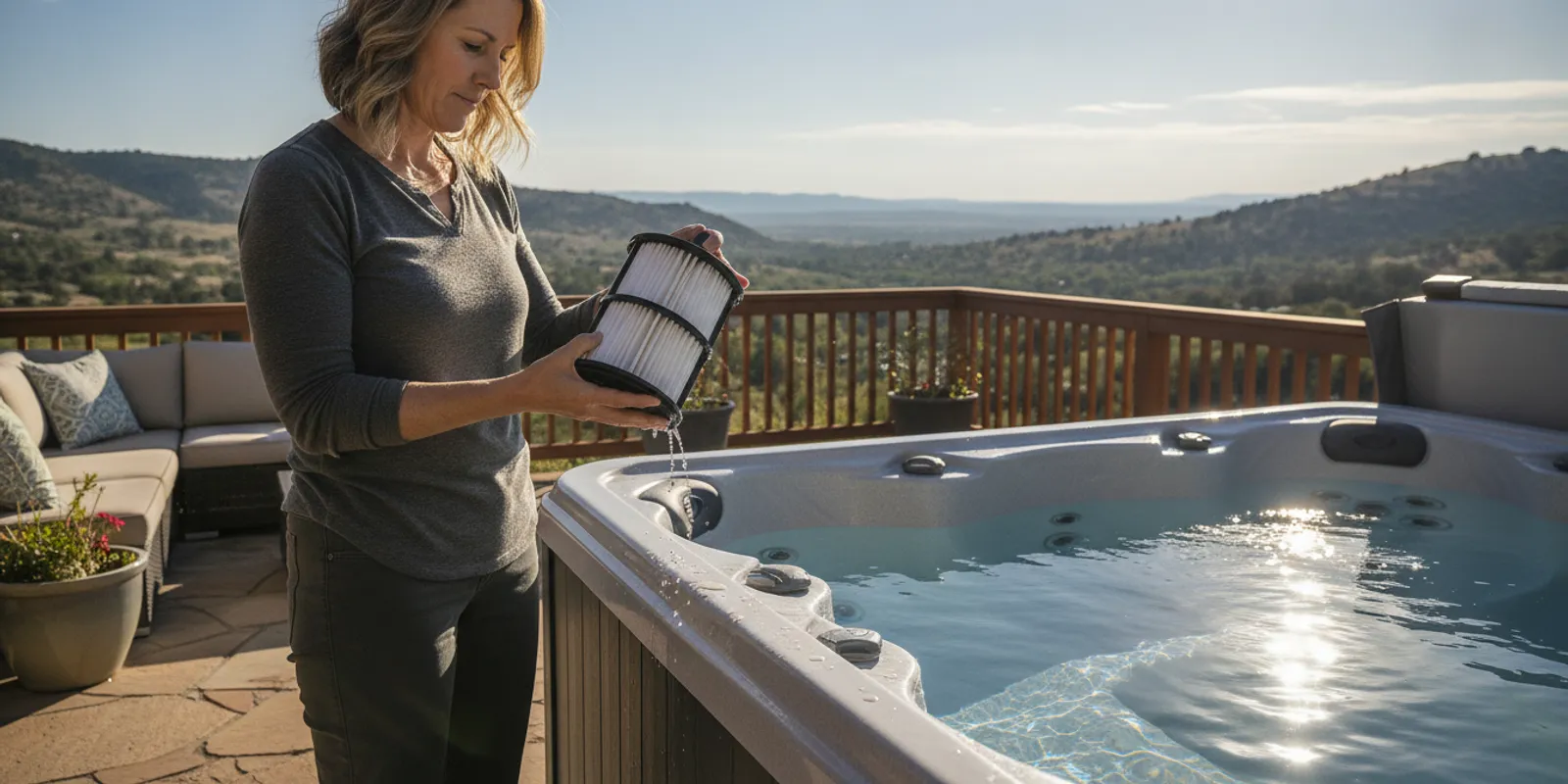
A dirty filter is not automatically a failed filter. If the cartridge is intact and the buildup is ordinary debris, thorough cleaning may restore useful flow. Follow the spa and filter manufacturers' cleaning instructions. In general, turn the spa off as directed, remove the cartridge carefully, rinse between pleats, and use only a cleaner approved for that filter when needed. Rinse away cleaner completely before putting the element back. For a broader spa-care routine, see Neptune Pools' step-by-step hot tub cleaning guide.
Do not use aggressive scraping, pressure that can damage the media, or household cleaners unless the manufacturer specifically allows them. A filter that is torn, misshapen, brittle, separating at an end cap, or unable to fit securely is a poor candidate for continued use. Persistent discoloration or deposits that do not rinse away may also justify a closer look, but appearance alone does not prove the cartridge has failed.
Use the table below as a decision aid, not a substitute for the spa manual. Actual replacement and service pricing depends on the particular filter and work requested, so ask for an itemized quote rather than relying on a generic online figure.
| What you find | Likely next step | What to confirm before spending |
|---|---|---|
| Loose debris; pleats and end caps are intact | Clean and reinstall according to the manufacturer | Confirm cleaning method and whether flow improves after reinstalling |
| Cartridge is cracked, torn, distorted, or will not seat | Replace with the exact compatible part | Verify model, part number, quantity, and fit |
| Filter looks serviceable but water remains cloudy | Check water balance, sanitizer routine, and other causes | Ask whether water testing or broader troubleshooting is needed |
| Weak flow continues with a clean, correctly fitted filter | Arrange equipment troubleshooting rather than repeatedly buying cartridges | Ask whether inspection includes pump, circulation path, and filter housing |
| Unknown model or damaged housing | Identify the spa and inspect the assembly before ordering | Clarify whether the visit covers identification, diagnosis, or both |
How do symptoms help you decide?
Pay attention to what changed and when. Reduced circulation after weeks of use may point to a loaded filter, but poor flow can also have other causes. Cloudy water can reflect water-care issues as well as filtration. If a cartridge is new and correctly installed but symptoms remain, replacing it again is unlikely to be a sound first step.
Cloudy or dull water
Check that the filter is installed properly and is not visibly damaged. Then review the spa's test results and recent use, including whether sanitizer and water balance are being maintained according to the spa manufacturer's directions. A filter cannot correct every water problem by itself. If the water does not clear after reasonable cleaning and water-care corrections, request water testing or service advice.
Weak jets or reduced circulation
First check for an obviously dirty cartridge and follow the manual's safe shutdown and cleaning steps. Confirm that the filter is seated as designed and that accessible intakes are not blocked. If flow stays weak with a clean, properly fitted filter, stop treating cartridge replacement as the only possible fix. A technician can assess whether the problem involves the filter housing, circulation path, or equipment.
Repeatedly dirty filters
Frequent buildup can relate to spa use, debris, water-care habits, or a filter that is too old or unsuitable. Keep notes on when the cartridge is cleaned, what you see in the pleats, and when symptoms return. A short record helps distinguish a one-time dirty filter from a recurring issue that needs a different solution.
For safe use and water-care context, consult public-health guidance such as the Centers for Disease Control and Prevention and follow the directions for your specific spa and chemicals. If you are unsure how to interpret your water or equipment symptoms, avoid guessing at chemical additions or assuming a replacement cartridge will resolve them.
Request help with hot tub filter cleaning, identification, or troubleshooting.
How can you avoid paying twice for the wrong fix?
Before you buy a cartridge, separate what you know from what you suspect. Write down whether the issue is a visible tear, an uncertain fit, reduced flow, cloudy water, or more than one symptom. Note when you last cleaned the filter and whether the problem changed afterward. This simple history can help a technician recommend a targeted next step instead of treating every symptom as proof that the filter is worn out.
It also helps to take photos before removing anything. Capture the spa model plate if it is accessible, the filter in place, and the removed cartridge from several angles. Do not remove panels or reach into equipment areas to find a label if doing so would be unsafe or outside the owner's instructions. If you order a part yourself, compare its compatibility information with the spa documentation and keep the packaging until you have confirmed the fit.
When the filter is still intact, ask whether cleaning and a follow-up check are reasonable before approving replacement. When it is visibly damaged, ask for confirmation of the replacement part and whether the spa uses a single cartridge or a coordinated set. If a new filter is being recommended to address cloudy water or poor jets, ask what other checks would distinguish a filter issue from water-care or equipment trouble. A clear explanation of the proposed work makes it easier to make an informed choice.
What should a filter replacement quote include?
A useful estimate explains what work is proposed, rather than giving only a cartridge price. When contacting a spa service provider, describe the symptom and ask whether the estimate includes:
- The correct replacement part, its quantity, and any relevant model or compatibility confirmation.
- Labor to remove the old filter and install the replacement.
- A check that the cartridge fits, seats, and seals as intended.
- Basic assessment of the original filter's condition and the reason replacement is recommended.
- Any separate water testing or additional equipment diagnosis, with approval requested before extra work.
- Whether the estimate changes if the model or filter housing differs from the information supplied.
Send the model information, photos, and a concise description of symptoms before the appointment or parts order. Ask whether the provider wants the spa's water test results or the old filter kept for inspection. Those small steps can reduce back-and-forth and help avoid buying an incompatible cartridge.
Does it make sense to replace the filter during a service visit?
It can be convenient to handle a known, correctly identified replacement during an existing spa appointment, but convenience does not remove the need to confirm the part and scope. Ask whether the technician can bring the right cartridge based on the model and photos you provide, or whether identification needs to happen first. If the filter is not confirmed in advance, find out whether the visit is for diagnosis only and how a later installation would be arranged.
Compare the total outlay, not just the part price. A do-it-yourself purchase may be a good fit when you know the exact cartridge and installation is straightforward. Service may be preferable when you are uncertain about compatibility, the filter bay is damaged, or symptoms point to another problem. A replacement part and a separate diagnostic visit can mean two costs, so ask whether the proposed visit can inspect the filter and investigate the symptom in one appointment. Have the provider explain any limits: a basic filter change may not include a full water analysis or equipment troubleshooting.
For either option, retain the part number, receipt, and date of installation. If the same flow or water issue returns, those details help determine whether the new element is still fitting correctly or whether attention should shift to another cause. This is more useful than repeatedly changing filters without tracking what changed.
When is a broader spa inspection warranted?
A filter replacement is a focused repair. A broader inspection may be worth discussing if the same issue returns soon after cleaning or replacement, the filter housing is damaged, the spa has persistent weak flow, or water symptoms continue despite following normal care instructions. It is also sensible to ask for diagnosis when the equipment displays a warning or the source of the problem is unclear.
Before authorizing additional work, ask what the technician will inspect and what is included in the visit. A filter can be part of the problem without being the only cause. Keeping the scope clear helps you decide whether to start with the cartridge, request troubleshooting, or handle the issue in stages. If you are weighing a recurring repair against replacement, this hot tub repair-or-replace guide offers a related planning perspective. Neptune Pools serves Denver Metro spa owners with spa cleaning and repair, and its service-area information can help you confirm whether your location is covered.
Get help checking your spa filter or arranging service.
Frequently Asked Questions
How much does hot tub filter replacement cost in Denver?
There is no dependable single price for every spa. Cost depends on the correct cartridge, how many filters the system needs, part availability, and whether you need labor or diagnosis. Request an itemized estimate that separates the filter from service work.
Can I replace a hot tub filter myself?
Often, a homeowner can replace an accessible cartridge if the exact compatible part is identified and the spa manual's steps are followed. Turn off equipment as instructed, avoid forcing the cartridge, and confirm it seats correctly. If you cannot verify the part or the housing appears damaged, get help before operating the spa.
How do I know if the filter needs replacement rather than cleaning?
Visible tears, a distorted shape, damaged end caps, or a cartridge that no longer fits securely are reasons to replace it. If the element is intact and simply has removable debris, manufacturer-approved cleaning may be enough. Continued cloudy water or weak flow requires looking at other possible causes as well.
Will a new filter fix cloudy water?
Not necessarily. A new, compatible filter can help when the old one is damaged or no longer filtering properly, but cloudy water can also involve water balance, sanitizer, usage, or circulation issues. Check the water and equipment rather than assuming a cartridge alone will solve the problem.
What information should I have before asking for a quote?
Gather the spa make and model, any filter part number, the number of cartridges, clear photos, and a short description of symptoms and recent cleaning. Mention whether the filter is damaged and whether weak flow or cloudy water continues after cleaning. This gives a provider a better starting point for confirming the part and work scope.
For a clear comparison, ask what is included, verify the filter fit, and treat recurring symptoms as a reason to diagnose the spa rather than repeatedly replacing parts. That approach helps Denver spa owners choose the next step based on condition and evidence, not guesswork.
Related Blogs