Pool Equipment Troubleshooting: Common Symptoms and Next Steps
Pool equipment troubleshooting is safest when you begin with the symptom, not by opening a pump or filter. A sudden change in circulation, pressure, sound, or a controller display can have several possible causes. Denver-area owners should also consider changing weather and seasonal operation. Start with checks you can make from a safe distance, record what you find, and leave electrical and mechanical repairs to a qualified technician.
Contact Neptune Pools about an equipment concern.
What should you check before troubleshooting pool equipment?
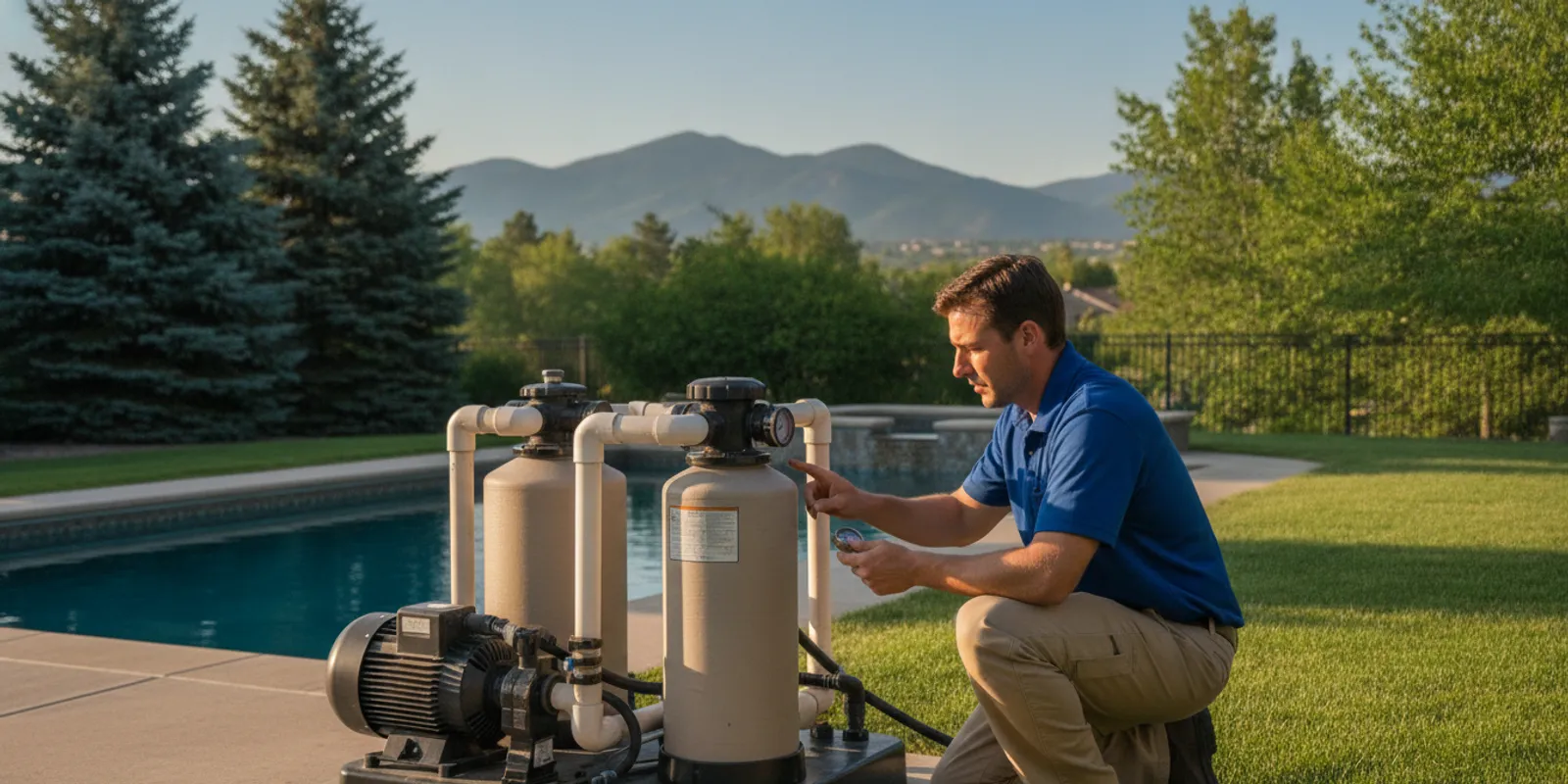
Gather a simple snapshot before you change any setting. Note the date and time, whether the pump appears to be on, whether water is moving at the returns, and what the gauge or controller shows. If you know the usual pressure reading or normal sound, write that down too. A comparison with the system’s own baseline is more useful than a number viewed without context.
- Check the pool water level visually. If it is below the skimmer opening, water may not enter the system as expected.
- Observe the pump, filter, and nearby plumbing without removing covers or reaching toward moving parts.
- Record an accessible gauge reading while noting whether the pump is running.
- Write down any exact warning or error code and the equipment model if visible.
- Look for water on the ground and note where it appears to come from and when it occurs.
- Recall recent weather, maintenance, power interruptions, or changes to settings.
Do not remove an equipment panel, handle wiring, bypass a safety device, or open a pressurized filter. If water is near electrical equipment, keep people away. General water safety information is available from the Centers for Disease Control and Prevention. For hands-on assessment, Neptune Pools provides pool equipment repair and servicing.
What can common pool equipment symptoms indicate?
This table is a triage aid, not a remote diagnosis. Similar symptoms can have different causes depending on the equipment and pool setup. Use it to decide what to observe and what to report, not as a repair checklist.
| Symptom | Safe observation | Prudent next step |
|---|---|---|
| No or weak circulation | Note water level, pump status, and whether returns appear to move water. | Stop the pump if it appears to run without flow; arrange assessment. |
| Pressure differs from normal | Record gauge reading, pump status, and recent filter service. | Do not open the filter; ask a technician if the change persists. |
| New noise or vibration | Listen from a safe distance and note when it begins. | Stop using equipment if the sound is severe; seek service. |
| Water near equipment | Note location and whether it appears during operation. | Keep clear of wet electrical areas and arrange inspection. |
| Error or warning code | Record the exact code and equipment model. | Check the model’s manual and do not bypass a safeguard. |
Why is there no circulation or weak water flow?
First look at the pool water level and the return flow, then note whether the pump seems to be operating. A low water level can affect water entering the skimmer. If the motor runs but water does not move as usual, possible explanations include an obstruction, a priming problem, a valve position, a filter condition, or a mechanical fault. These are possibilities, not a diagnosis based on sound or appearance alone.
If the pump appears to be running without adequate water flow, switch it off using a normal control if that control is dry and safely accessible. Do not keep restarting it to see whether the symptom clears. Avoid opening the pump lid, reaching into a basket, or dismantling plumbing. Record whether flow stopped suddenly or weakened over time and whether anything changed just beforehand. A technician can assess the intake, pump, valves, filter, and plumbing as a system.
Compare what you see at more than one return only from a safe position. If every return seems weak, report that pattern; if only one seems different, note that too. This distinction does not identify a failed part, but it helps describe whether the change seems system-wide or localized. Also mention if circulation changes after a scheduled controller cycle, a recent service visit, or a weather event. Do not adjust several valves to experiment, since the original setting may be difficult to reconstruct and the result can complicate diagnosis.
For recurring care that can help identify changes in operation, review Neptune’s pool cleaning and maintenance service. Routine maintenance does not replace repair when a pump stops moving water or shows a new fault.
What does a pressure change mean?
A filter pressure gauge is most informative when compared with the normal reading for that pool under similar operating conditions. A higher or lower value can signal a change in flow or system condition, but the gauge alone cannot tell you exactly what failed. Record the number, whether the pump is on, and whether the reading changed after recent service or a change in valve position.
Make the comparison consistently: note whether the pump has been running, whether the reading is steady or moving, and whether circulation looks different at the same time. If you do not know the baseline, do not guess that a particular number is normal for every pool. Include the gauge’s condition in your report. A cracked, stuck, fogged, or unreadable gauge is itself useful information, but not a reason to remove it or attempt a repair.
Do not loosen a filter clamp, remove a filter lid, or open plumbing to investigate. A system can retain pressure after the pump is switched off. If pressure is outside the pool’s usual range and flow or equipment behavior has changed, arrange a professional check. A technician can interpret the reading alongside the filter type, pump operation, and the rest of the system.
What should you do about pump noise or vibration?
A new hum, rattle, squeal, or grinding sound deserves attention, especially when it comes with reduced circulation, vibration, or a warning. Listen from a safe distance. Note whether it starts at startup, continues throughout operation, or stops when the pump is off. Do not touch a running motor or reach near a fan, shaft, or other moving part.
If equipment smells burnt, becomes unusually hot, trips a breaker, or makes a loud grinding sound, stop using it and request professional assessment. Do not repeatedly reset a breaker or force the motor to start. Electrical diagnosis and motor repair belong with a qualified technician. Neptune’s pool services page outlines service options, and the Denver Metro service areas page helps owners check coverage.
When describing a sound, use ordinary words rather than deciding what component caused it. “A rattle begins a few seconds after startup” is more helpful than “the bearing is bad” unless a technician has confirmed that diagnosis. Note if the noise is new, intermittent, or continuous and whether the equipment also vibrates or stops. If it changes with operation, observe from a distance and do not restart the unit merely to reproduce the sound.
How should you respond to a leak around pool equipment?
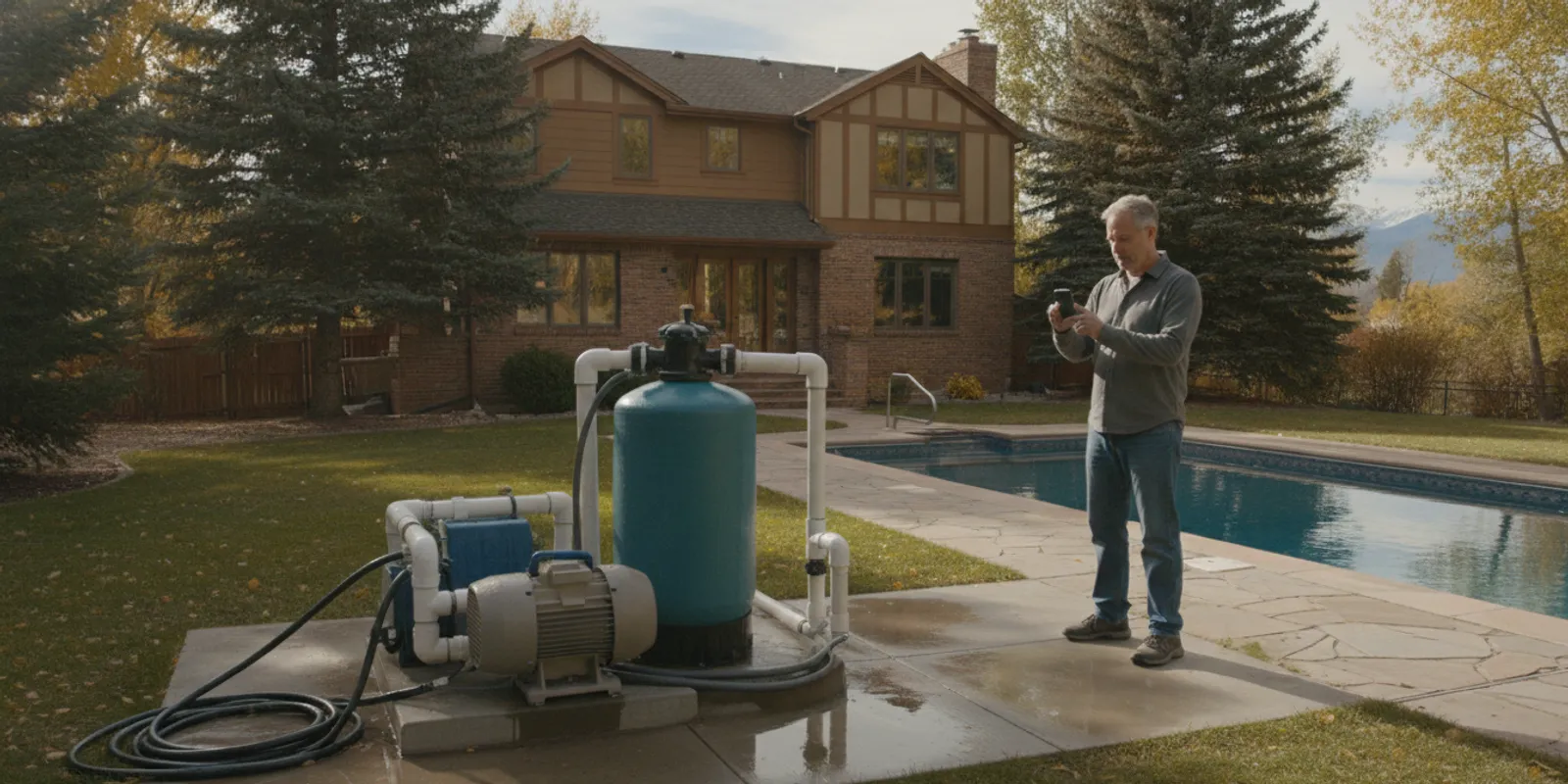
Water near a pump, filter, heater, or pipe connection may come from different sources. Without touching the equipment, note where water first appears, whether it forms only when the system is running, and whether the amount seems to be increasing. A photo taken from a dry, safe distance can help communicate the location. Avoid assuming that every wet patch means a failed component.
Keep water away from electrical controls. Do not touch wet wiring, tighten fittings, or work on equipment while it may be pressurized. If water is steady, worsening, or close to electrical equipment, keep people clear and arrange prompt help. Note whether the pool level seems to be changing, but do not enter an unsafe equipment area to investigate. For general service information, see information about Neptune Pools and its Denver-area operations.
A useful leak report separates observation from inference. For example, state that a damp area appears beneath a pipe connection after the pump starts, rather than stating that the connection has failed. If the wet area is present whether the system is on or off, record that distinction. Do not place towels or tools against electrical equipment, and do not attempt to contain water by moving or disconnecting a pipe.
How do you handle an equipment error code?
Write down the exact code, the device displaying it, and any accompanying message or indicator light. Record the model number if you can read it without opening a panel. Consult the owner’s manual for that specific model, since codes and their meanings differ between manufacturers and equipment types. Also note what the system was doing when the message appeared.
Do not clear a recurring alert simply to keep equipment running, and never bypass a sensor or safety feature. If the message returns, the manual is unclear, or the equipment stops, share the code and model with a technician. Neptune’s pool care FAQs may help with general service questions, but they do not replace model-specific diagnosis.
If a display cycles through several messages, record each one in order and note whether the pump or other equipment was operating. Photographing the display can reduce transcription mistakes, provided you can do so without approaching a wet or unsafe area. Avoid resetting the controller repeatedly: clearing a message may remove useful context without addressing the underlying condition.
Which checks are safe for a homeowner?
Keep initial troubleshooting to observation and information gathering: check water level, read a visible gauge, record a display, listen from a safe distance, and note where water appears. Use normal controls only when they are dry, accessible, and functioning as intended. Use the manufacturer’s manual to understand ordinary status indicators.
Leave electrical work, motor disassembly, pressurized filter opening, internal equipment inspection, and plumbing repairs to trained professionals. Never work with wet hands or stand in water while approaching equipment. Do not assume that switching off a pump has removed pressure from a filter or made every component safe to handle.
Denver weather adds a seasonal consideration. When freezing conditions are expected, the right protection depends on the pool, equipment, and operating conditions. Do not assume a single setting or action is right for every system. If you are unsure how a pool or its equipment should be protected, ask a local professional. Neptune offers pool closing and winterization services.
After a cold snap or a sharp change in weather, make a visual check for new warning messages, unexpected water, or a change in pump sound, but only if the equipment area is dry and safe to approach. A quiet system may be in a scheduled off period rather than malfunctioning, so compare the observation with the normal controller schedule before drawing a conclusion. Do not change freeze settings based on general advice alone; the appropriate approach depends on the equipment and pool.
What information should you share when requesting service?
A short, organized report can make the first service conversation more useful. Share what you observed rather than presenting a guess about the failed part. Include:
- The symptom and when it began, including whether it appeared suddenly or gradually.
- Whether the pump runs and whether water appears to circulate.
- The visible pressure reading and the normal reading, if known.
- The exact warning code and equipment make or model, if available.
- Where water appears and whether you see it only while equipment runs.
- Any recent weather, maintenance, power interruption, or setting change.
- Whether you turned equipment off, and why.
Put the details in chronological order. For example: “The pump sounded normal on Monday; on Tuesday morning the display showed a code, and the return flow looked weaker.” Include what you have not checked as well as what you have. Avoid interpreting a pressure reading without context or stating that a particular component is broken before inspection. Clear observations help keep the first conversation focused on the actual symptom.
Do not approach unsafe equipment to collect a detail. A missing model number is less important than staying clear of water near electrical components. Neptune serves Denver Metro homeowners and property managers. Use the contact page to describe the symptom, or review HOA pool service information if you are reporting an issue for a community pool.
Frequently Asked Questions
Should I keep running the pump if water is not circulating?
No. If the pump appears to run without moving water, switch it off using a normal control if safe and arrange professional assessment. Do not keep restarting it to test the system.
Can I open the filter to look for a blockage?
Do not open a filter unless you are trained and can follow the manufacturer’s complete pressure-release procedure. Equipment may retain pressure even after the pump stops, so internal inspection should be handled with care.
What if equipment is wet near a power connection?
Keep away and do not touch the equipment, wiring, or controls. Arrange professional help. Use a shutoff only if it is safely accessible from a dry location without approaching the wet area.
Does an error code prove that a part has failed?
No. A code reports a condition detected by that equipment; its meaning depends on the specific model. Record the code and consult the manual or a technician if it recurs or the cause is unclear.
When should I request pool equipment service?
Request service when a symptom persists, circulation stops, a leak worsens, a motor develops a severe new sound, a warning returns, or electrical safety is uncertain. Stop short of disassembly and share the observations you collected.
Request help with pool equipment troubleshooting.
Careful observations can help a technician understand what changed, but they are not a substitute for safe diagnosis. When a symptom involves electricity, pressure, moving parts, or uncertain freeze protection, leave the repair to a qualified pool equipment technician.
Related Blogs