Commercial Pool Maintenance Denver: Expert Guide

Commercial pool maintenance denver services must address three intersecting factors: high-altitude water chemistry that accelerates chlorine dissipation. Freeze-thaw cycles that stress underground and above-ground plumbing, and Colorado Department of Public Health and Environment (CDPHE) regulations that mirror the CDC Model Aquatic Health Code. A comprehensive plan includes daily or every-other-day chemical testing, weekly equipment inspections, seasonal winterization with full line blowouts, and digital record-keeping for health department audits. Neptune Pools has delivered certified commercial pool care in Denver since 1982, tailoring every service plan to the specific demands of Front Range properties. This approach keeps pools operational through Colorado's brief but intense swim season and protects the substantial capital investment in pool infrastructure through the long winter months.
Why Denver Commercial Pool Maintenance Is Different
Denver's 5,280-foot elevation, semi-arid climate with 300+ days of annual sunshine. And dramatic temperature swings create a maintenance environment that differs fundamentally from pool operations in coastal or lower-altitude markets. Facility managers must account for faster chemical degradation, higher evaporation rates, freeze damage risk from October through April. And state-level health code enforcement that follows the CDC MAHC risk classification system.
Managing a commercial pool at a mile high changes the basic science of water care. The lower atmospheric pressure at Denver's elevation allows dissolved gases to escape more readily, which shifts pH readings upward. At the same time, the intense UV radiation at this altitude breaks down free chlorine 30 to 50 percent faster than at sea level. A commercial pool that tested perfectly balanced at 9:00 AM can drift out of compliance by noon on a sunny July day if the chemical feed system is not calibrated for high-altitude conditions.
Our Denver commercial pool technicians adjust chlorine feeder output and pH controller setpoints specifically for Front Range conditions. They verify every adjustment with on-site digital testing rather than assuming the chemistry will hold.
The freeze-thaw cycle presents an equally serious challenge. Denver averages 47 nights per year below freezing, but those freezing events cluster unpredictably. A 70-degree afternoon in October can be followed by a 20-degree overnight low that flash-freezes standing water in plumbing lines. At commercial facilities with hundreds of feet of underground pipe runs. The expansion force of freezing water can generate over 2,000 PSI inside a pipe rated for 200 PSI. That is why proactive winterization is not optional for Denver properties. It is a direct financial hedge against repair bills that routinely run $1,500 to $3,500 per freeze event. The cost of professional blowout service is roughly $500, which makes the math straightforward.
How Often Should a Commercial Pool Be Cleaned in Denver?
Unlike residential pools that can go a week between service visits, commercial pools in Denver require daily or every-other-day attention during the April-through-September swim season. The combination of high bather loads, rapid chemical dissipation at altitude. And accumulated debris from Denver's semi-arid environment means that gaps of more than 48 hours between service visits risk water quality violations.
The frequency question depends primarily on bather load and facility type. A 200-room hotel pool in downtown Denver that sees 40 to 60 swimmers per day during summer needs daily testing and chemical adjustment. An HOA pool serving 80 homes with moderate weekend use may maintain compliance with every-other-day service. However, the common mistake property managers make is treating commercial pool frequency as a fixed schedule when it should be a dynamic response to real-time water conditions.
Denver's afternoon thunderstorms introduce organic debris and dilute chemical concentrations in uncovered pools. This requires an immediate post-storm test to prevent algae bloom within 24 hours. Each commercial pool cleaning and maintenance visit includes skimming and surface debris removal, brushing tile and walls to prevent calcium scale and biofilm accumulation. Emptying skimmer and pump baskets, recording chemical readings, and adjusting chemical feed equipment as needed.
The goal is to maintain consistent water quality that will pass a health department inspection at any moment. Not just to keep the pool looking clear to the casual eye. Turbidity that is invisible in a bucket sample can register on a calibrated turbidimeter and trigger a failed inspection. Which is why professional-grade testing equipment is part of every service call.
Commercial Pool Maintenance Denver: What's Included in a Full Service Plan
A comprehensive commercial maintenance plan in Denver covers four domains: water chemistry management calibrated for high-altitude conditions. Mechanical equipment inspection and preventative maintenance, filter system cleaning and media replacement scheduling, and digital documentation for health department compliance. Each domain requires specific technical expertise that goes beyond standard residential pool care.
Water Chemistry Management at Altitude
Stable water chemistry in a Denver commercial pool requires a fundamentally different approach to chemical dosing. The accelerated UV breakdown of chlorine means that many facilities need supplemental stabilization through cyanuric acid (CYA) management. But CYA levels above 50 ppm reduce chlorine efficacy and can mask unsafe water conditions. Our technicians test for CYA levels monthly and recommend partial drainage and refill when concentrations approach the upper threshold. For indoor commercial pools where UV is not a factor, the pH drift caused by Denver's lower atmospheric pressure becomes the primary challenge. Carbon dioxide off-gassing happens more rapidly at altitude, driving pH upward faster than standard pool chemistry textbooks predict.
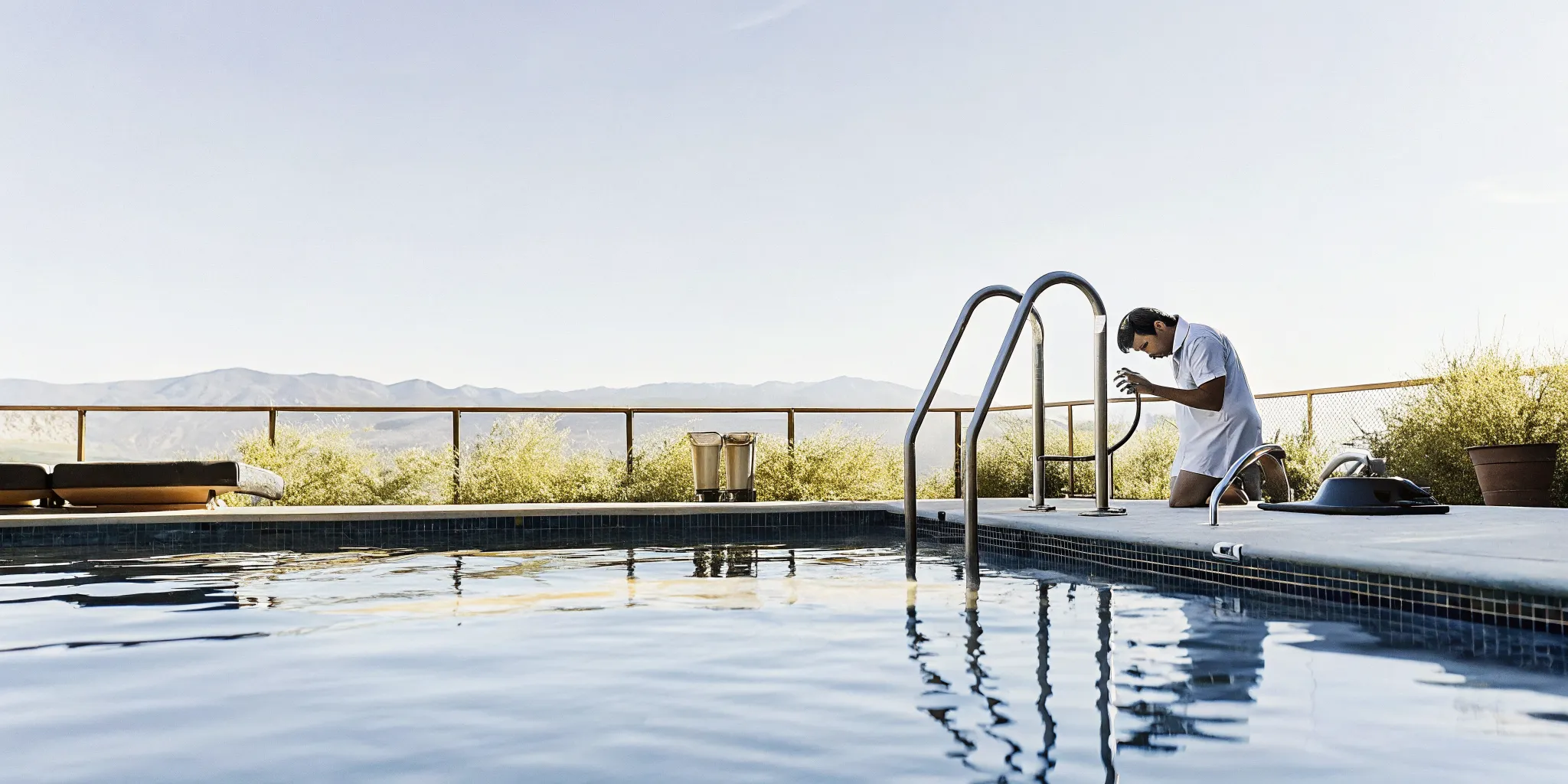
Alkalinity and calcium hardness also require altitude-adjusted targets. Denver's municipal water supply comes primarily from snowmelt and reservoir collection in the Rocky Mountains. Giving it a naturally low total dissolved solids (TDS) level compared to well-water-sourced regions. This low starting TDS means the water is more chemically reactive and requires precise initial balancing when the pool is filled. We track Langelier Saturation Index (LSI) values on every commercial account to prevent both corrosive water and calcium scaling, both of which accelerate equipment degradation. For properties that prefer to manage their own chemical inventory, we offer Denver pool chemical delivery with products pre-selected for Front Range water conditions.
Mechanical Equipment Inspections
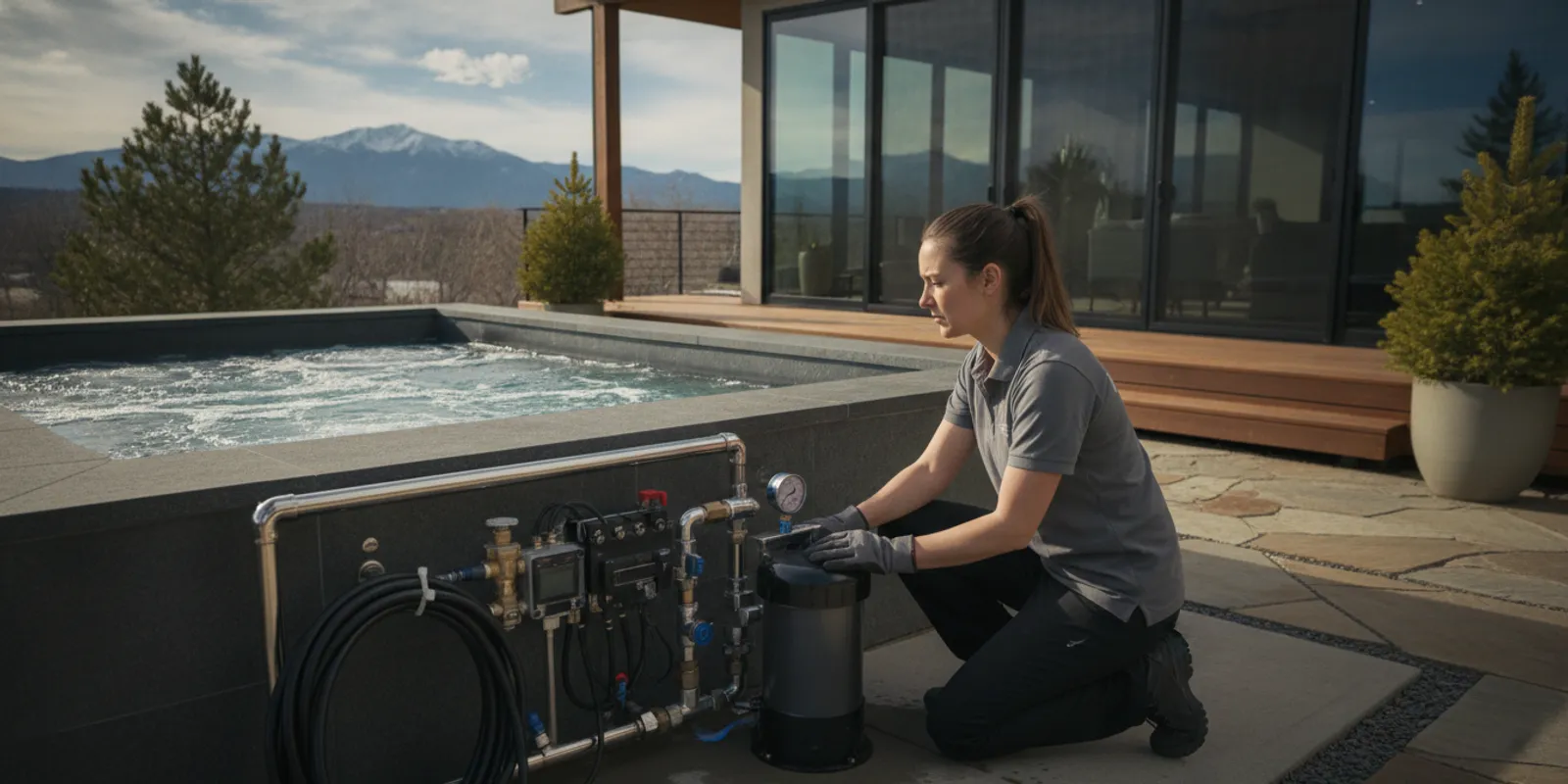
The mechanical heart of a commercial pool pump, filter bank, heater, chlorinator, and control system operates under different stress profiles in Colorado than in warmer climates. The pump room must be maintained above freezing even when outdoor temperatures drop below zero, which adds a freeze-stat or space heater inspection to every winter service visit. Pump seals dry out and crack more readily in Denver's low-humidity environment, making quarterly mechanical seal inspections a cost-effective preventative measure. A failed pump seal on a 5-horsepower commercial pump costs roughly $400 to replace if caught early, versus $1,800 or more if the leak damages the motor windings.
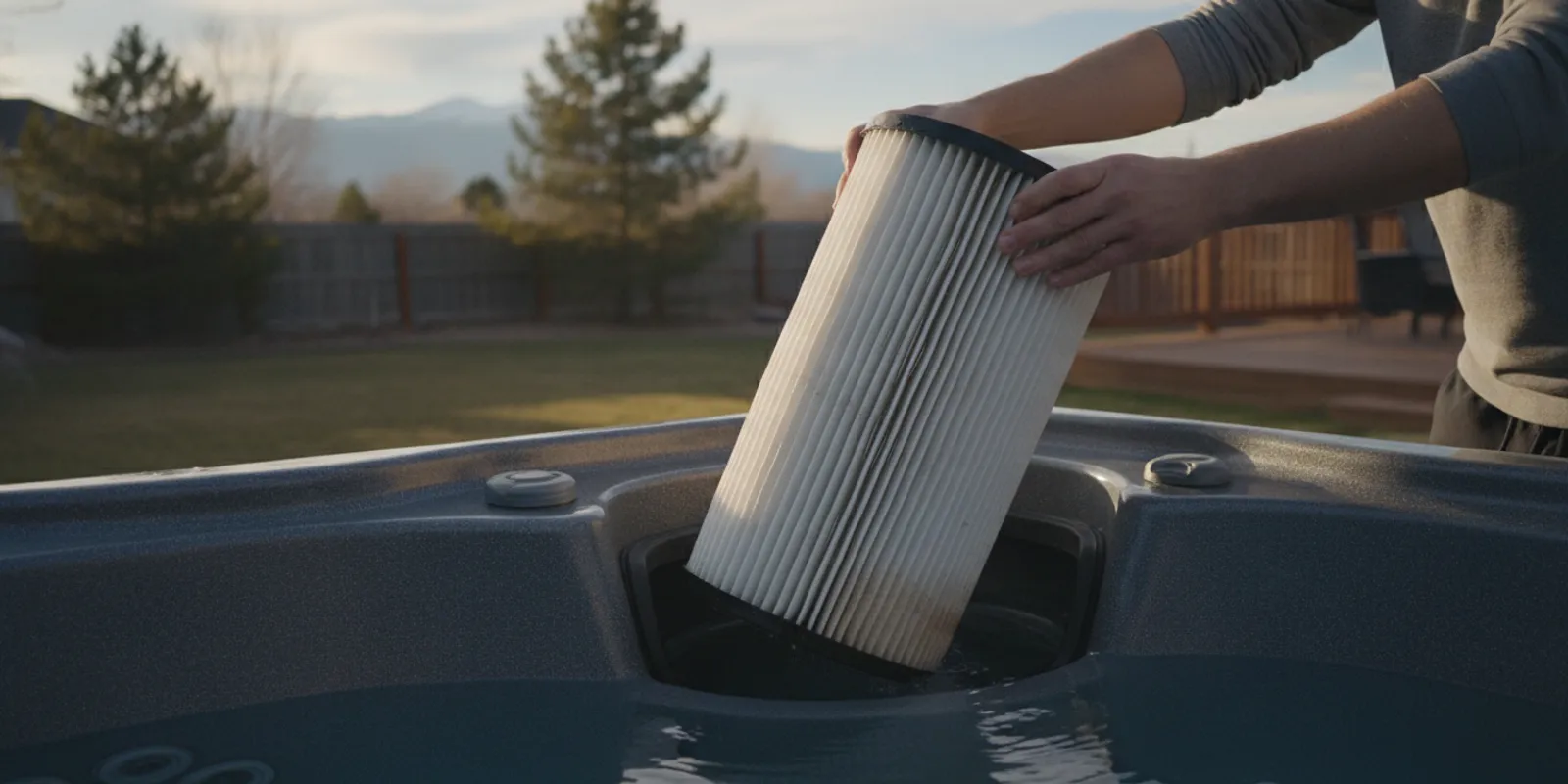
Filter maintenance follows different pressure baselines at higher flow rates caused by thinner air. A commercial pool equipment repair specialist must calibrate backwash triggers to actual flow readings rather than relying on generic pressure gauge targets. We record clean-filter and dirty-filter pressure readings for each system and adjust the backwash schedule accordingly. Typically extending filter runs during the lower-debris shoulder months and increasing frequency during peak summer leaf and pollen seasons.
Health Department Compliance for Denver Commercial Pools
All public and semi-public pools in Colorado must comply with CDPHE regulations that follow the CDC Model Aquatic Health Code (MAHC) framework. Compliance involves passing an annual spring inspection, maintaining daily chemical logs, ensuring proper enclosure and safety equipment, and staffing or contracting with certified pool operators. Failure on critical items can result in immediate pool closure.
The CDPHE classifies commercial pools by risk category based on facility type, bather load, and historical compliance record. Hotels and apartment complexes typically fall into higher-risk categories that require more frequent inspections. The inspection criteria cover six major areas: water quality and disinfection, recirculation and filtration system performance, safety equipment availability, enclosure integrity, chemical storage and handling, and record-keeping. Each category has specific pass-fail criteria. And a failure in any critical item such as inoperable gate latches or chlorine levels outside the 1-4 ppm range results in an immediate violation notice.
| Inspection Area | Critical Fail Items | Consequence |
|---|---|---|
| Water quality | Chlorine outside 1-4 ppm, pH outside 7.2-7.8 | Immediate closure |
| Enclosure safety | Gate gaps over 4 inches, broken self-latching mechanism | Immediate closure |
| Recirculation system | Inoperative pump, filtration by-pass | Closure until repair |
| Safety equipment | Missing ring buoy, no shepherd hook within reach | Citation + 30-day fix |
| Chemical storage | Improper labeling, incompatible chemicals together | Citation + 30-day fix |
| Record-keeping | No daily chemical logs for past 30 days | Citation + 30-day fix |
Spring inspections in Denver typically occur between April 15 and May 31. Scheduling the inspection requires booking weeks in advance with the local health authority. Missing this window because the pool is not ready can delay opening until the next available inspector slot. Which in a busy season could mean two to three weeks of lost pool availability. For a hotel in peak tourism season, that lost amenity directly impacts booking rates and guest satisfaction scores.
We work with our commercial clients to prepare the inspection-ready packet: chemical logs from the previous 30 days. Equipment maintenance records, CPO certification documentation, and a pre-inspection self-audit checklist. This preparation typically reduces the inspection itself to a 15-minute verification rather than a discovery process. The CDC provides a facility inspection reference guide that outlines the risk-based inspection framework. We train all our commercial service technicians on the specific inspection criteria used by Denver-area health officials. When violations are identified, we provide a prioritized remediation plan that distinguishes between items requiring immediate correction and those that can be scheduled over a 30-day compliance window.
How to Winterize a Commercial Pool in Colorado
Winterization for a Denver commercial pool involves five critical steps: lowering the water level below the tile line. Blowing out all plumbing lines with compressed air to remove standing water. Installing expansion plugs and pool-grade antifreeze in traps and skimmers. Fully draining and drying all pump filter and heater components, and installing a secure safety cover rated for the pool dimensions. Proper winterization is the single most cost-effective investment a property can make, preventing $1,500 to $3,500 in freeze damage.
The window for winterization in Denver typically opens between October 1 and November 1, depending on the specific property location and long-range forecast. A Front Range property in Lakewood at 5,500 feet may need winterization two to three weeks earlier than a pool in downtown Denver at 5,280 feet. Our technicians monitor the 10-day forecast for each commercial account and begin scheduling winterization when sustained overnight lows approach 28 degrees Fahrenheit.
The winterization process follows a specific sequence that must not be shortcut:
- Lower the water level to six inches below the tile line, or the manufacturer-recommended level for the specific pool type and cover system.
- Blow out all return lines, main drain lines, skimmer lines, and any auxiliary lines with a commercial-grade air compressor delivering at least 90 CFM. Each line must be blown until no moisture exits the far end.
- Install threaded or expansion plugs in all line openings. Use pool-grade antifreeze in skimmers, pump traps, and any low-point drain traps that cannot be fully cleared.
- Drain and disassemble pump strainer baskets, remove filter drain plugs, open heater drain ports, and verify every component is completely dry. Even one cup of water left in a heater heat exchanger can crack the casting during a freeze.
- Install the winter cover rated for the pool dimensions with proper water tubes or springs tensioned per manufacturer specs. Verify no standing water collects on the cover surface.
After winterization, freeze protection sensors should be installed and tested. These sensors automatically activate the circulation pump when water temperature approaches 38 degrees Fahrenheit, providing a second layer of defense against unexpected cold snaps. For properties with year-round spa or hot tub operations that share equipment with the main pool. We isolate the spa circulation loop so winterization of the pool system does not affect spa availability.
If freeze damage does occur despite these precautions, do not attempt to pressurize or operate the system until a full inspection is completed. Running a pump with a cracked volute or operating a heater with a split heat exchanger can flood the equipment pad and cause a total system failure. Our commercial pool equipment repair team can diagnose and replace damaged components before the spring opening, typically completing repairs within 48 hours for stocked parts.
Choosing a Commercial Pool Maintenance Partner in Denver
The right commercial pool maintenance partner brings regulatory knowledge, altitude-adapted chemistry expertise, and validated commercial insurance and licensing. Look for a company with CPO-certified technicians, digital reporting tools, verifiable commercial references in the Denver market, and a demonstrated understanding of CDPHE regulations and MAHC compliance requirements.
Not all pool service companies are equipped to handle commercial accounts. Residential pool technicians often lack the equipment and training for commercial-grade chemical feeders, variable-speed pump programming, and large-scale filtration systems. When evaluating a commercial pool maintenance partner in Denver, request documentation of their CPO certifications and ask specifically about their experience with high-altitude water chemistry adjustments. A provider that cannot explain how they adjust chlorine feeder output for Denver's UV index is not equipped for the local environment.
Reporting transparency is another critical differentiator. The days of paper log sheets left on the equipment room floor are over. A professional commercial provider should offer digital service reports with timestamped chemical readings, equipment condition photos, and a running maintenance history accessible to the property management team. Neptune Pools provides digital reporting with photos after every service visit. Creating an auditable trail that satisfies health department record-keeping requirements and gives property managers verifiable proof that maintenance obligations are being met.
Finally, verify commercial liability insurance coverage, workers compensation coverage, and any special licenses required by the local jurisdiction for commercial pool chemical handling. A provider should be able to produce certificates of insurance upon request and name the property as an additional insured. These protections are not administrative overhead. They are essential risk management for the property owner.
Frequently Asked Questions
What is the difference between residential and commercial pool maintenance in Denver?
Commercial pools face higher bather loads, stricter health department oversight, and more complex mechanical systems than residential pools. Denver commercial maintenance requires daily or every-other-day service during the swim season, CDPHE-compliant record-keeping, CPO-certified technicians, and equipment calibrated for high-altitude chemistry. Residential pools typically receive weekly service with less rigorous documentation requirements.
How much does commercial pool maintenance cost in Denver?
Commercial pool maintenance pricing in Denver varies by facility size, service frequency, and equipment complexity. Most full-service plans range from $500 to $2,000 per month for chemical testing, cleaning, equipment inspections, and digital reporting. Winterization is typically a separate seasonal fee. Contact Neptune Pools for a quote tailored to your specific property.
Do I need a certified pool operator for my Denver commercial pool?
Colorado regulations require that commercial pool facilities have a designated certified pool operator (CPO) responsible for water quality and equipment safety. This can be a staff member who holds a current CPO certification or a contracted service provider whose technicians carry CPO credentials. Neptune Pools maintains CPO certification across all commercial service technicians.
How long does a commercial pool winterization take?
A full commercial pool winterization in Denver typically takes four to eight hours depending on pool size, number of plumbing lines, and equipment complexity. Neptune Pools schedules winterizations between October 1 and November 1 and completes the process in a single service visit with no disruption to other property operations.
What happens if my commercial pool fails a health inspection?
A failed health inspection results in a violation notice with specified correction deadlines. Critical violations such as inoperative gate latches, insufficient chlorine levels, or broken recirculation equipment can result in immediate pool closure until the issue is corrected and re-inspected. Non-critical violations typically carry a 30-day correction window. Neptune Pools provides remediation support and re-inspection preparation for all commercial clients.
Ready to schedule a commercial pool maintenance consultation?
Your commercial pool is a significant asset that deserves maintenance expertise specific to Colorado conditions. Neptune Pools brings four decades of Denver experience, CPO-certified technicians, digital reporting. And a track record of helping hotels, apartment communities, and HOAs maintain compliant, operational pools through every season. Call 303-431-8501 to schedule a consultation or visit our commercial pool services page to learn more about our Denver maintenance programs.
Related Blogs