Pool Chemical Calculator: Safer Dose Estimates
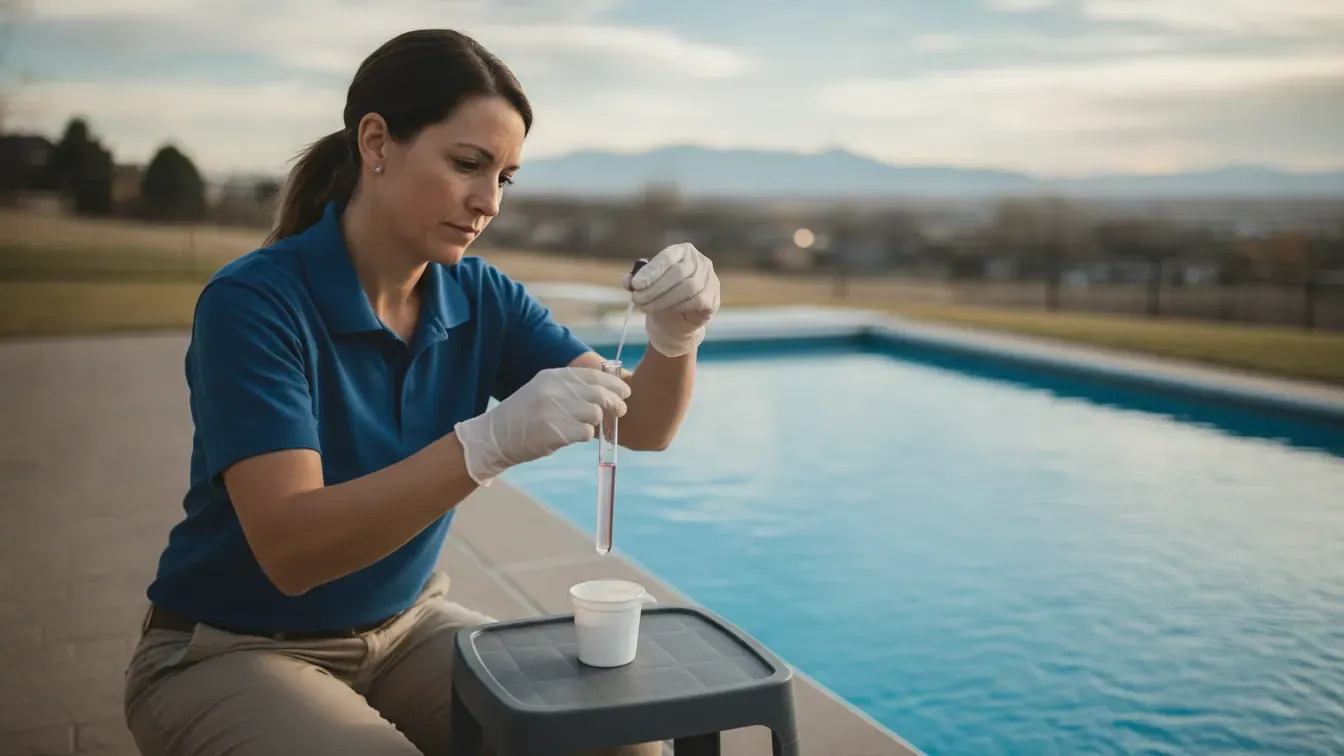
A pool chemical calculator can help turn a water test into a more deliberate treatment plan, but the number it produces is only as reliable as the information behind it. Before adding anything, you need a reasonable estimate of pool volume, a recent test reading, a target range, and the exact strength of the product you plan to use. A calculator can scale the math. It cannot replace the product label, safe handling, or professional judgment.
Shop Neptune Pools supplies and chemicals for Denver pool care.
This guide explains the inputs behind pool chemical calculations, shows a conservative way to estimate treatment amounts, and identifies situations when a homeowner should stop dosing and request professional water testing. It is written for residential pool owners, including Denver Metro homeowners dealing with hard source water, strong sun, dry air, and seasonal temperature swings.
What does a pool chemical calculator need?
Most calculators ask for more than the name of a chemical because treatment depends on the relationship between the water, the reading, and the product. The essential inputs are:
- Pool volume: the number of gallons being treated, not the size printed on an old sales document unless you have confirmed it.
- Current reading: a recent measurement for the parameter you are adjusting, such as free chlorine, pH, total alkalinity, calcium hardness, or cyanuric acid.
- Target reading: the destination selected for your pool, sanitizer system, surface, and test method.
- Product identity and strength: liquid chlorine, cal-hypo, dichlor, muriatic acid, sodium bisulfate, baking soda, stabilizer, calcium chloride, and salt do not have interchangeable strengths.
- Water conditions: pH and alkalinity interact, while free chlorine targets depend on the sanitizer system and stabilizer level. A single reading rarely tells the whole story.
If any of these inputs is a guess, treat the result as a rough starting point rather than a dose to add all at once. The safest workflow is test, calculate, add conservatively, circulate, and test again.
How to calculate pool volume before estimating a dose
Every treatment estimate scales with water volume. If your volume is wrong by 20 percent, the calculated amount is also wrong by about 20 percent. That is why volume is usually the most important input in a pool chemical calculator.
For a rectangular pool, use this basic estimate:
Length in feet x width in feet x average depth in feet x 7.48 = approximate gallons.
Use the average depth, not the deepest point. Measure the shallow and deep areas, add them, and divide by two. For a round pool, calculate the surface area with the radius, multiply by average depth, then multiply by 7.48. For an irregular pool, divide the shape into smaller rectangles or sections, estimate each section, and add the results.
Adjust the estimate for attached spas, tanning ledges, benches, unusual coves, and water levels that differ from the normal operating level. Above-ground pools may have a manufacturer capacity, but confirm whether that capacity assumes a particular fill height. If the result is far from an older service record, do not automatically choose the larger number. Recheck the measurements or ask a professional to confirm the volume.
How the treatment amount is estimated
A practical label-based calculation uses a known product rate for a known change in a known volume. The general structure is:
Estimated amount = label amount x actual pool volume divided by label volume x desired change divided by label change.
For example, if a label gives an amount for a 10,000-gallon pool and a specific increase, scale the label amount by your pool's volume and by the gap between your current and target reading. This is a framework for understanding the calculation, not permission to ignore the label. Product formulas and concentrations change, and some products are not appropriate for every pool surface or sanitizer system.
For chlorine, the calculation must account for the desired increase in free chlorine and the percentage of active ingredient in the product. A useful mass-balance check is:
Pounds of active chlorine needed = gallons x desired ppm increase x 8.34 divided by 1,000,000.
To estimate the amount of product, divide the active ingredient requirement by the product's active fraction, then convert to the unit shown on the label. Liquid products also have density and concentration differences, so do not assume that one gallon of one chlorine product equals one gallon of another. Granular products add other ingredients and may change cyanuric acid or calcium. A product label or professional calculation should control the final dose.
Which test readings change the calculation?
Free chlorine
Free chlorine is not a fixed amount for every pool. The target depends on the pool's sanitizer setup and stabilizer level, as well as the condition of the water. A calculator needs the current free-chlorine reading and the target increase. If the pool has visible algae, heavy contamination, or a high combined-chlorine reading, a routine maintenance dose may not address the underlying problem.
Do not use a calculator to make a blind shock addition. Test first, follow the product label, protect swimmers from untreated or actively treated water, and retest before making another correction.
pH and total alkalinity
pH is one of the least forgiving readings to estimate from a simple chart. Total alkalinity acts as a buffer, so two pools with the same pH can require different amounts of acid or base. Product concentration, water temperature, cyanuric acid, aeration, and the pool surface also affect the result.
That is why a safe pool chemical calculator should ask for alkalinity before estimating a pH adjustment. If a tool gives one universal acid amount without asking for current pH, alkalinity, volume, and product strength, treat its output cautiously. The CDC's healthy swimming guidance is a useful safety reference, but your product label and current test remain the controlling sources for an addition.
Calcium hardness and cyanuric acid
Calcium hardness and cyanuric acid are easy to misunderstand because adding a product raises them, but there is no bottle that safely removes an excessive level through a normal chemical reaction. Lowering either one generally requires dilution with fresh water, partial draining, or a water-management plan appropriate for the pool.
Do not keep adding treatment because the water looks cloudy or feels rough without testing calcium hardness. Hard Front Range source water can make scale management especially important for Denver-area pools. If the result is far outside the range recommended for your surface and equipment, professional testing can prevent a cycle of additions that makes the imbalance worse.
Salt and saltwater systems
A saltwater pool still uses chlorine. The salt cell makes chlorine from salt, but the system has a manufacturer-recommended salt range and operating conditions. Use the cell's manual and a current salt reading rather than copying a target from a different model. If salt is too high, adding another product will not solve it. Dilution may be required, and the effect of water replacement depends on the actual water volume.
How to use a pool chemical calculator safely
- Test the water first. Use a clean sample taken according to your kit instructions. If a strip result conflicts with a drop-based test or the water condition looks unusual, do not average the readings.
- Confirm the pool volume. Recheck dimensions, average depth, water level, and attached features before relying on the output.
- Choose the exact product. Record the active ingredient, concentration, and label instructions. Do not substitute a different strength without recalculating.
- Set a reasonable target. Use the product label, equipment manual, pool-surface requirements, and professional advice where appropriate.
- Calculate the starting amount. When the result is uncertain, start below the calculated maximum if the label permits and plan a retest. Never exceed the label directions.
- Prepare the area. Keep people and pets away, wear the label-required protective equipment, and make sure circulation is operating as directed.
- Add one product at a time. Never mix pool chemicals together. In particular, keep chlorine products and acids separated. Do not add water to concentrated acid. Follow the label for whether a product should be broadcast, pre-dissolved, or added in another way.
- Circulate and wait. Allow the product to disperse for the time stated on the label. A same-minute test is not a reliable basis for another dose.
- Retest before adding more. Record what you added and compare the new reading with the target. Stop if the result moves unexpectedly.
A calculator is most useful as part of this loop. It is not a reason to make several unmeasured additions in a single afternoon.
Ask Neptune Pools about professional pool maintenance and water-care support.
Why conservative dosing matters in Colorado
Denver Metro pools can face strong sunlight, dry air, hard source water, rapid weather shifts, and a long period of seasonal use. Those conditions can change evaporation, dilution, chlorine demand, and scale risk. They also make it tempting to chase a test result with another product before the first addition has fully circulated.
Conservative dosing protects against the most common calculation errors: an inflated volume estimate, an incorrect product strength, a test taken from a poor location, a target copied from another pool, or an interaction between pH and alkalinity. A small correction followed by a proper retest is easier to evaluate than a large correction followed by several new problems.
Keep a simple treatment record with the date, test results, pool volume, product name, product strength, amount added, weather, and retest result. The record helps identify recurring water loss, unusual chlorine demand, source-water changes, or a test-kit problem. It also gives a technician useful information if you need help.
When should you stop using a calculator and call a professional?
Stop estimating and request professional water testing when any of these conditions apply:
- You do not know the pool volume and cannot make a reasonable measurement.
- Readings are contradictory, change sharply between tests, or do not respond as expected after circulation.
- The water is green, severely cloudy, has visible deposits, or has a strong chemical odor that does not improve with correct testing and circulation.
- pH, alkalinity, calcium hardness, stabilizer, or salt is substantially outside the range recommended for your equipment and surface.
- You suspect a leak, a failing salt cell, a damaged heater, poor circulation, or a filter problem is driving repeated chemical corrections.
- A chemical was mixed, spilled, inhaled, splashed, or stored incorrectly. Follow the product's emergency instructions and seek appropriate emergency help.
- You are preparing a pool opening, closing, winterization, or major water replacement and want a complete baseline rather than a single adjustment.
Professional testing is especially valuable when the same imbalance returns after several dose-and-retest cycles. The cause may be circulation, source water, equipment, testing technique, or a parameter that was never measured.
Use Neptune Pools as your Denver resource for pool chemicals and water-care guidance.
Pool chemical calculator questions
Can I calculate a dose without knowing my pool gallons?
No. You can make a rough volume estimate, but a treatment amount without a reasonable gallon count is guesswork. Measure the pool or have a professional confirm the volume before making a significant addition.
Why did the calculator give a different result for the same pH?
pH treatment depends heavily on total alkalinity, current conditions, product strength, and the desired change. Two pools with the same pH can need different amounts. Recheck the test and use the exact product information.
Should I add the entire calculated amount at once?
Not automatically. Follow the label, use a conservative starting correction when the situation allows, circulate for the required time, and retest before adding more. Never exceed the label directions.
Can I use a calculator for a spa?
The same ideas apply, but a spa has a much smaller volume and can change quickly. Use spa-specific product directions and equipment guidance. If the water is irritating, cloudy, or repeatedly difficult to balance, request professional testing rather than making repeated small guesses.
Contact Neptune Pools for help with pool water testing and treatment planning.
Related Blogs