Pool Pump Installation Cost in Denver
Understanding pool pump installation cost in Denver starts with the equipment already on your property. It is not always a simple equipment swap. The right installation plan depends on what is on the pad. It also depends on whether the plumbing and electrical setup can support the selected pump, and whether related repairs are needed.
Request a site-specific pool equipment installation assessment from Neptune Pools.
There is no responsible universal pool pump installation cost for every Denver pool. A useful estimate should account for the existing equipment, pump type and compatibility, plumbing and electrical conditions, access, and any repairs required before startup. Neptune Pools does not publish a standard pump installation price, so a site-specific review is the clearest way to understand the work involved.
That review should explain what installation includes, from removing and connecting equipment to priming, testing, and checking operation. It should also separate pump work from electrical or plumbing changes and keep Colorado freeze protection in view. Here is what to ask about before accepting a quote.
What Does Pool Pump Installation Include?
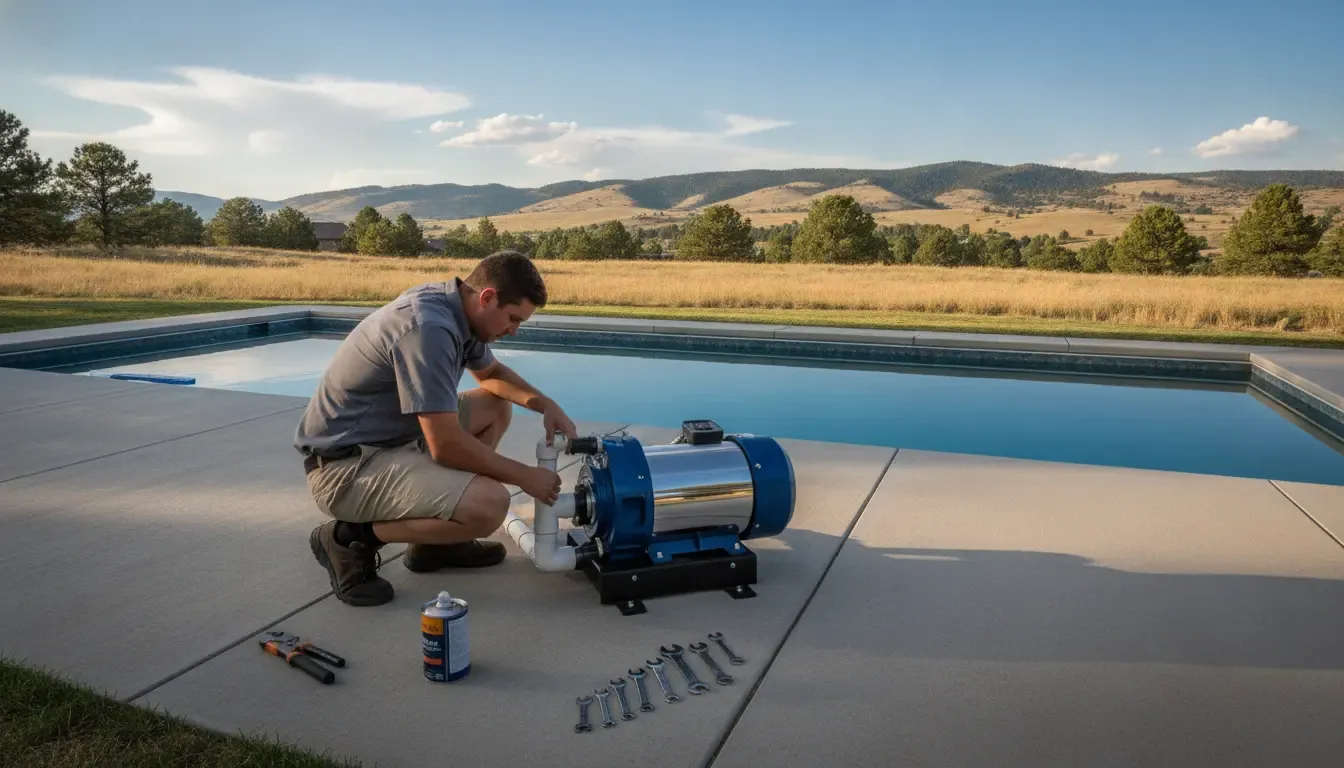
Pool pump installation is more than removing one unit and setting another in its place. A complete installation reviews equipment compatibility, removes the existing pump, connects the replacement, starts and primes the circulation system, and verifies that the system operates as intended.
Equipment review and removal
The process begins with the existing equipment and the needs of the pool. The technician reviews the pump type, motor arrangement, plumbing connections, controls, and surrounding equipment before recommending a suitable replacement. Neptune supports variable-speed and single-speed pumps, along with pump and motor combinations. That range helps keep the recommendation tied to the pool's actual setup rather than assuming that every replacement should use the same model.
After the equipment review, the old pump is disconnected and removed. The technician can identify parts that should be retained, replaced, or evaluated before the new pump is installed. Neptune's equipment service includes factory-trained technicians for major brands, OEM parts sourcing, and warranty-compliant installation and configuration. Learn more about pool equipment repair and installation service.
Connections, startup, and priming
Installation includes making the necessary plumbing and equipment connections for the selected pump. Electrical scope must be assessed by the qualified professional responsible for that work. If the surrounding system needs repair or adjustment, those findings should be identified as part of the installation scope instead of being hidden behind a simple swap.
Once connections are complete, the circulation system is started and primed. Priming helps establish water flow through the pump before normal operation is evaluated. A proper startup also gives the technician an opportunity to check for leaks, unusual operation, and connection issues while the equipment is running.
Verification and inspection
The final stage is not simply turning the pump on. Equipment operation should be verified and the system inspected after startup. Neptune documents these activities in its pool-opening work, including equipment reassembly, startup, circulation-system priming, operation verification, and system inspection. Review pool equipment startup and inspection services.
This inspection creates a clearer handoff: the homeowner can understand what was installed, what was adjusted, and whether additional work should be addressed separately.
What Factors Shape Pool Pump Installation Cost?
A responsible pool pump installation cost estimate starts with the pool and equipment already on site. There is no universal Denver price because the scope can change with the existing equipment, electrical and plumbing conditions, selected pump, and repairs required. Neptune does not publish pump, labor, or installation prices, so a site-specific review is more useful than a generic number.
Existing equipment and compatibility
The estimate should account for the current pump, motor, filter, valves, controls, and equipment pad. A replacement that matches the existing connections may have a different scope from an installation that requires equipment repositioning or new controls. Pump selection also matters. Efficient motors and variable-speed technology can deliver flow suited to different tasks, including filtration and cleaning, according to ENERGY STAR guidance. More efficient or multispeed equipment may have a higher initial cost than standard equipment. But the right choice depends on the pool's actual operating needs, not a larger horsepower assumption.
Plumbing, electrical, and access conditions
Existing plumbing can vary around the equipment area, and its condition, route, connections, and available space may affect the installation plan. If plumbing changes are being considered, review the Denver pool plumbing installation planning resource alongside the pump scope.
Electrical work should be evaluated separately by the qualified professional responsible for that work. The required review can depend on the existing setup and the selected equipment. Neptune's available information does not establish specific electrician arrangements, permit requirements, or code requirements, so those details should be confirmed for the property rather than assumed.
Use this checklist when reviewing a quote
- Does it identify the existing pump, motor, filter, controls, and equipment pad?
- Does it explain why the proposed pump is compatible with the pool and circulation system?
- Does it identify any plumbing condition, connection, or access issue?
- Does it state whether electrical evaluation is included, separate, or still required?
- Does it list controls, startup, testing, and any required repairs as separate scope items?
- Does it distinguish the installation plan from seasonal winterization, which requires a pool-specific approach?
A clear scope makes competing estimates easier to compare and helps prevent needed repairs from appearing as surprises after work begins.
How Pump Type and Sizing Affect the Installation Plan
The right pump is not necessarily the largest pump available. It needs to match the pool's circulation demands, plumbing, controls, and equipment layout. A smaller, higher-efficiency pump can save energy when it is properly matched and operated for the pool's needs. While an oversized pump may create unnecessary flow and integration challenges. The guide to how to choose a pool pump can help frame the decision before an on-site assessment.
| Pump option | Best-fit planning question | Controls and flow | Integration consideration |
|---|---|---|---|
| Single-speed | Does the existing system need a straightforward, consistent operating profile? | One operating speed and a relatively simple control setup. | Confirm that the pump, plumbing, filter, and existing controls work together. |
| Variable-speed | Would different circulation tasks benefit from adjustable operation? | Multiple speeds can provide flow suited to filtration, cleaning, or water features. | Review controller compatibility, programming, wiring, and the hydraulic layout. |
| Pump and motor combination | Can the motor or pump assembly be addressed without replacing every connected component? | Performance depends on the selected combination and the existing pump body. | Verify fit, connections, condition, and whether the configuration remains warranty-compliant. |
ENERGY STAR reports that certified in-ground pool pumps use up to 65% less energy than standard pumps. But that national benchmark is not a promise for every pool or installation. Efficient motors, hydraulic design, and variable- or two-speed technology are useful only when the selected equipment delivers the flow the system actually requires. Size should therefore follow measured conditions and intended use, not a general assumption that more horsepower is better.
Neptune supports single-speed and variable-speed pumps, as well as pump and motor combinations. A site review can identify whether the proposed equipment fits the pad, connections, controls, and service needs. For broader equipment planning, see energy-efficient pool equipment in Denver.
Request a site-specific pump installation assessment from Neptune Pools.
What Electrical and Plumbing Work Should a Denver Quote Address?
A pump installation quote should distinguish the pump itself from the work needed to connect and support it. Existing equipment, electrical and plumbing conditions, the selected pump, and any required repairs can all change the scope of a Denver installation. A clear assessment should explain which items are included, which conditions need correction, and which work requires another qualified professional.
Separate the pump from electrical service
The pump may be a straightforward equipment replacement, but the electrical portion still deserves its own review. The assessment should identify the existing connection, controls, disconnect location, and compatibility with the selected pump. A variable-speed pump may also involve different control or programming considerations than a basic single-speed replacement. The person qualified to perform or approve electrical work should determine the appropriate scope for the property. Do not assume that a pump quote automatically includes electrical service, upgrades, or any particular permit process.
Check plumbing routes, connections, and the equipment pad
Plumbing changes depend on how the existing system is arranged. The reviewer should look at the suction and return lines, valves, fittings, connection points, and the available space around the equipment pad. Pipe routes may not be uniform from one pool to another. A public homeowner discussion, for example, describes different pipe sizes in different parts of one equipment area. But it is only an illustration, not a design standard or authority for a Denver project. The practical question is whether the selected pump can be connected to the existing system without leaving poor access, unnecessary rework, or an unaddressed restriction.
Access matters as much as the visible connection. Tight equipment areas, damaged pad surfaces, buried or difficult-to-trace lines, and controls located away from the pump can add inspection and coordination requirements. For broader planning around routes, equipment location, and access, see Denver pool plumbing installation planning.
Ask for a scope that can be verified
Before approving an estimate, ask whether it identifies the pump model, removal and connection work, electrical review, plumbing changes, controls, testing, and any excluded repairs. This separation makes the pool pump installation cost easier to evaluate because you can compare the actual work rather than a single unexplained total. It also helps prevent a needed electrical or plumbing correction from being mistaken for part of the pump price.
How Does Colorado Freeze Protection Change Pump Planning?
Installing a pool pump and preparing a pool for winter are related decisions, but they are not the same service. A new pump still needs to be selected, connected, configured, primed, and checked for proper operation. Winterization addresses how the entire circulation system should be protected when seasonal conditions require a shutdown or a different operating plan.
Plan for the pool's seasonal operating condition
Colorado freeze risk should be part of the planning conversation, especially for pools exposed to rapid temperature changes, but one winter procedure does not fit every pool. The right approach depends on the equipment layout, plumbing, controls, exposure, water management, and whether the pool will remain in service during cold weather. A pump replacement should not automatically be treated as a winter closing, and a winter closing should not be assumed to resolve an installation issue.
For a seasonal closing, documented activities can include adjusting the water level for freeze protection, shutting down equipment. Blowing out lines to help prevent freeze damage, installing the winter cover, and performing a winter risk inspection. Those steps should be evaluated for the specific pool rather than copied from a generic checklist. The timing and sequence may also depend on weather and the owner's operating plan.
Account for altitude and equipment protection
Altitude can affect how equipment is evaluated and configured in Colorado. Neptune states that its certified technicians receive Colorado climate training that includes freeze protection and altitude adjustments. That local knowledge can help identify questions about pump setup, circulation, and seasonal protection before work begins. But the final plan should be based on the actual pool and equipment in front of the technician.
Before approving installation work, ask whether the scope separates pump installation from winterization. Identifies any needed line protection and shutdown steps, and includes a post-work inspection or operating check. For more detail on seasonal planning, review Colorado pool equipment freeze protection. A pool-specific assessment is the safest way to coordinate the pump, plumbing, water level, and cold-weather plan without assuming that one procedure is universal.
When Should You Repair, Replace, or Install a New Pump?
The right choice depends on the pump's symptoms, physical condition, compatibility with the rest of the circulation system. And the scope of work needed to return it to reliable operation. A repair may make sense when the underlying pump is a good fit and the problem can be addressed with an appropriate part. Replacement deserves consideration when the existing equipment is poorly matched, difficult to support, or no longer meets the pool's operating goals.
Start with the actual failure
Noise, leaking, loss of prime, poor circulation, repeated shutdowns, or a motor that will not start can have different causes. A technician should inspect the pump and surrounding equipment before recommending a path. Neptune's equipment service includes factory-trained technicians for major brands and OEM parts sourcing, which helps separate a repairable component issue from a broader equipment problem. For a deeper decision guide, see pool pump repair or replacement.
Compare fit, condition, and future use
Replacement is not simply a matter of choosing a larger motor. The new pump must work with the pool's plumbing, filtration, controls, and expected circulation needs. If efficiency or operating flexibility is a goal, an upgrade consultation can help determine whether a different pump type is appropriate. Neptune supports variable-speed and single-speed pumps, as well as pump and motor combinations, so the recommendation can reflect the existing setup rather than a one-size-fits-all assumption.
Confirm the installation will be set up correctly
Whether the job involves a repair or a new installation, configuration matters. The equipment should be tuned for the system and installed in a warranty-compliant manner, with operation checked after the work. Ask what is included in the assessment, which repairs are required before startup, and whether the recommended equipment is compatible with the current system. Equipment repairs continue year-round, so a pump problem does not necessarily need to wait for the active pool season.
Request a site-specific pool equipment repair or installation assessment from Neptune Pools.
Frequently Asked Questions About Pool Pump Installation Cost
What is the average pool pump installation cost?
There is no responsible universal average for Denver. A site-specific estimate depends on the existing equipment, electrical and plumbing conditions, selected pump, access, and any repairs required. Neptune Pools does not publish a standard pump installation price, so a quote should explain the actual work rather than rely on a generic calculator.
Can I install a pool pump myself?
A simple equipment swap may look straightforward, but pump installation can involve water connections, priming, controls, and electrical work. Have the electrical portion assessed by the qualified professional responsible for that work, and confirm the completed system is configured and operating correctly before relying on it.
Can an electrician install a pool pump?
An electrician may handle the electrical scope, but that does not automatically cover pump selection, plumbing connections, priming, circulation checks, or equipment configuration. Ask the quote to separate electrical work from pool-equipment installation so each responsibility is clear.
What affects the cost of installing or replacing a pool pump?
The main variables include pump type and size, compatibility with the existing system, pad and access conditions, pipe layout, electrical condition, controls, and repairs discovered during inspection. A qualified assessment should match flow needs to the pool and equipment instead of assuming a larger pump is better.
How does Colorado freeze protection affect pump installation?
Freeze protection should be planned for the specific pool and season, not treated as one universal procedure. Depending on the system, winter planning may involve shutdown, water-level adjustment, line protection, and a risk inspection. Installation and winterization are separate decisions, so discuss both when planning work in Denver.
Plan Your Pool Pump Installation With Neptune Pools
A site-specific assessment can clarify whether your current equipment, plumbing, electrical setup, and seasonal needs support the installation plan you have in mind. Neptune Pools can review the existing conditions and help define a practical scope for your Denver property. To discuss your project, contact Neptune Pools for a pool pump installation assessment.
Related Blogs