Pool Water Chemistry: Colorado Balancing Basics
How to Master Pool Water Chemistry in Colorado
Clear water does not always mean balanced water. In Denver Metro, dry air, strong sun, hard Front Range water, high altitude, and fast temperature swings can change a pool's readings faster than many owners expect.
Explore Neptune Pools' water testing and chemical delivery services for Denver Metro pools.
Understanding pool water chemistry helps protect swimmers, surfaces, plumbing, pumps, and heaters. It also helps you avoid adding chemicals based on guesswork.
What Does Pool Water Chemistry Control?
Pool water chemistry is the relationship between pH, total alkalinity, calcium hardness, sanitizer, and stabilizer.
Keeping these measurements in balance helps chlorine work effectively, supports swimmer comfort, limits scale and corrosion, and protects pool equipment. Colorado conditions make routine testing especially important. Weather and source water can shift the balance quickly.
Water can look clean while its chemistry is already stressing a pool. High pH can reduce chlorine effectiveness. Low pH can make water more corrosive.
Excess calcium can contribute to scale, while too little calcium may allow water to pull minerals from plaster, grout, or metal. Testing reveals these risks before appearance alone does.
How pH and Total Alkalinity Work Together
pH measures how acidic or basic pool water is. The CDC identifies 7.0 to 7.8 as the pool pH range that supports swimmer comfort, disinfection, and component protection.
When pH rises above 8.0, chlorine becomes significantly less effective at killing germs. When pH falls below 7.0, water can become more corrosive to pipes and equipment. The CDC's pool testing guidance explains the connection between pH, chlorine, and equipment.
Total alkalinity acts as a buffer that helps resist rapid pH changes. A commonly used reference range is 80 to 120 parts per million.
The right adjustment depends on the pool, sanitizer system, source water, and test results. If alkalinity is out of range, correcting pH alone often provides only temporary relief.
Why Calcium Hardness Matters in Denver
Calcium hardness measures dissolved calcium in the water. If it is too low, water may pull minerals from plaster, grout, and metal components.
If it is too high, calcium can contribute to scale on surfaces, inside plumbing, and on heaters. Neptune Pools uses 200 to 400 ppm as a practical calcium hardness range for protecting many pool surfaces and equipment.
Hard Front Range water makes this reading worth monitoring during opening, after significant water replacement, and whenever white deposits or rough surfaces appear.
Calcium hardness should not be adjusted in isolation. Consider the pool finish, source water, pH, alkalinity, temperature, and circulation before selecting a treatment.
How Sanitizer and Stabilizer Fit the System
Free chlorine is the active sanitizer available to control germs. It is consumed by swimmers, dirt, sunlight, and warm water, so adding it on a fixed calendar is less reliable than testing.
Combined chlorine is chlorine that has reacted with contaminants. A rising combined-chlorine reading can help explain odor, eye irritation, or water that feels less fresh even when free chlorine is present.
Cyanuric acid, or chlorine stabilizer, helps protect chlorine from the sun. That can matter along the Front Range, where strong ultraviolet exposure can speed chlorine loss.
Stabilizer also slows chlorine's germ-killing activity, so it should be measured rather than added automatically. The CDC advises against using cyanuric acid in hot tubs.
Which Pool Water Chemistry Readings Matter Most?
The most useful pool water chemistry readings answer different questions. pH shows whether water is too acidic or basic. Alkalinity shows how resistant pH is to change. Calcium hardness indicates the risk of mineral loss or scale. Free chlorine, combined chlorine, and cyanuric acid explain sanitizer strength, contamination, and sunlight protection.
These readings interact, so a single number rarely explains the entire problem. Adding more chlorine may not solve cloudy water if pH is high, circulation is weak, or a filter is loaded. A complete result gives you a better basis for measured action.
Understanding pH
Use pH as a first-line comfort and performance measurement. A result that is too high can make chlorine less effective and encourage scale.
A result that is too low can increase irritation and corrosion risk. Follow the test kit and product label for the exact correction process, then retest after the required circulation time.
Total Alkalinity
Alkalinity helps keep pH from bouncing. If pH repeatedly rises or falls after correction, test alkalinity before adding another pH product.
Correcting the buffer can make later pH adjustments more stable. Do not assume that a standard range applies identically to every pool, finish, or treatment system.
Calcium Hardness
Calcium hardness deserves extra attention with Denver-area source water. High calcium can show up as scale on tile, plumbing, or heaters. Low calcium can contribute to surface or component damage.
Test after opening, substantial water replacement, or a change in water source. Then interpret the result with pH and alkalinity.
Free Chlorine, Combined Chlorine, and CYA
Free chlorine is the available sanitizer, combined chlorine is the reacted portion, and cyanuric acid helps shield stabilized chlorine from ultraviolet light.
Together, these readings explain why a pool may need closer observation after heavy use, bright sun, hot weather, or a storm. Never treat a chlorine reading without considering the whole water and circulation system.
Why Does Colorado Weather Change Water Balance?
Colorado weather creates several overlapping pressures on pool water chemistry. Dry air and wind increase evaporation. That can concentrate dissolved minerals as water leaves the pool. Strong sunlight can accelerate chlorine consumption. Warm water and heavy use increase sanitizer demand. A cold front can alter temperature and operating habits quickly.
Elevation is one factor, not the whole explanation. A pool can be carefully adjusted for local conditions and still drift after a hot, windy week or a major storm.
The useful response is not to make a larger blind chemical dose. Test again, record the weather and pool use, and identify which reading actually changed.
Temperature swings are especially important in spring and fall. A cool night followed by intense sun may change evaporation and chlorine demand within a short period.
In freezing weather, chemistry does not replace winterization or freeze protection. Equipment shutdown, line protection, water level, and circulation decisions remain separate parts of responsible seasonal care.
Watch the Pool After High-Impact Events
Test after heavy swimmer use, thunderstorms, unusual heat, significant debris, major water replacement, or an extended equipment interruption. Also test before and after opening.
Startup water often needs coordinated adjustments. Changing one measurement without checking the others can create a second problem.
Keep a simple record of date, time, water temperature, weather, pool use, and results. Trends are more informative than a single color match.
If the same imbalance returns despite consistent testing, inspect filtration and circulation as well as the chemistry.
For a narrower discussion of elevation-related evaporation and mineral management, read Neptune Pools' high-altitude pool water chemistry guide. For testing frequency and seasonal timing, see how often to test pool water in Colorado.
How Should You Test and Balance a Colorado Pool?
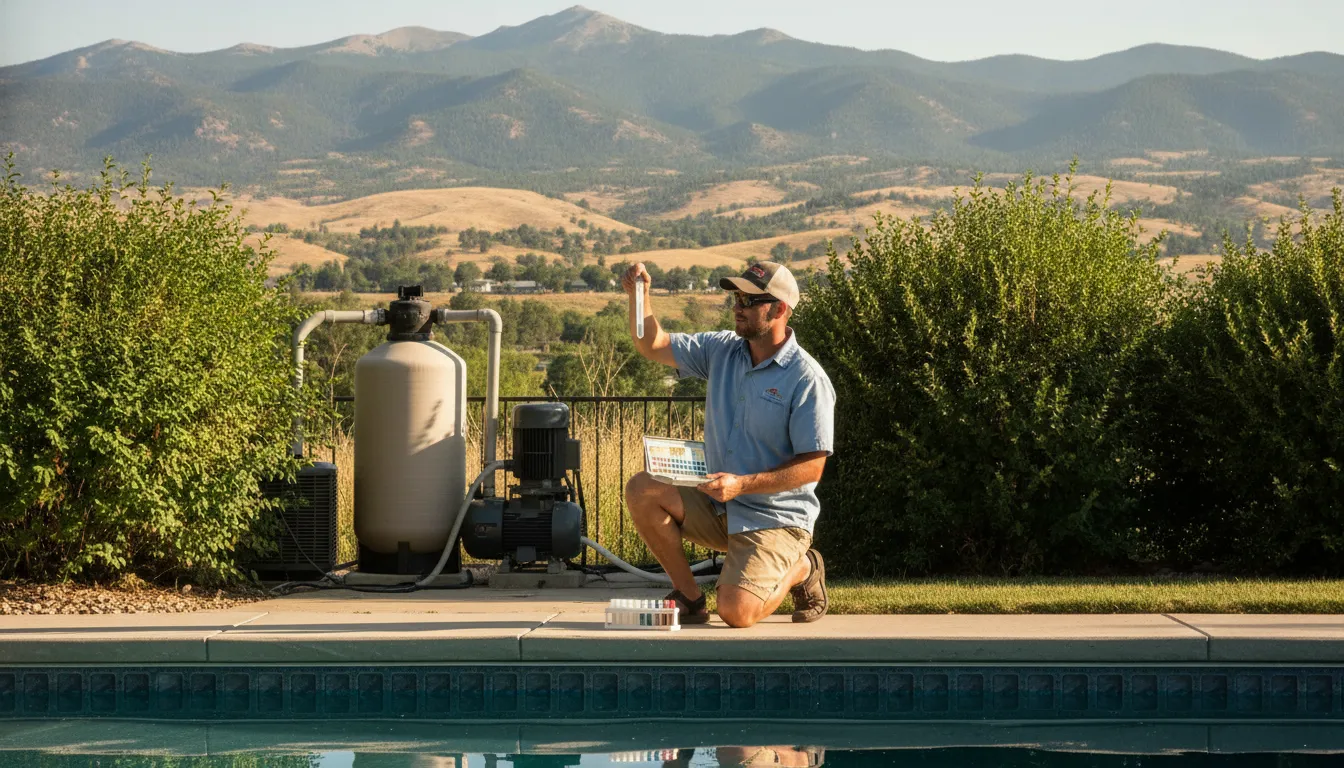
A dependable pool water chemistry routine starts with a representative sample. Test pH and sanitizer before any adjustment, then check supporting readings. Consider weather, temperature, use, circulation, and filtration together. Make one measured change at a time, follow the product label, allow the specified mixing period, and retest before making another correction.
Use a clean kit, follow its instructions, and record results at roughly the same time of day when possible.
- Collect a representative sample. Follow the kit directions, usually collecting water below the surface and away from return jets. Test free chlorine and pH first. Record the result, water temperature, recent weather, and unusual pool use.
- Check supporting readings. Test total alkalinity to understand pH stability. Check cyanuric acid when the pool uses stabilized chlorine. Check calcium hardness on the seasonal schedule or after water replacement. Use reference ranges as starting points, not as permission to make rigid dosing promises without a complete test.
- Interpret the pattern. Consider pH, sanitizer, alkalinity, calcium, water temperature, sunlight, swimmer load, debris, circulation, and filter condition together. High pH can reduce chlorine performance. Low chlorine may reflect demand from sunlight, warm water, contaminants, or poor circulation.
- Make one measured adjustment. Calculate the dose from the tested water volume. Follow the product label and safety instructions. Never mix chemicals or combine products in a container. Allow the required circulation and waiting period before deciding whether another correction is needed.
- Retest after change or event. Retest after the label's specified interval and after heavy use, storms, heat, major debris, opening, or a significant water change. If the result is surprising, confirm the sample or method instead of chasing the number with more chemicals.
Owners who want a deeper maintenance checklist can review Neptune Pools' pool cleaning and maintenance services. The service process includes water chemistry testing and adjustments, equipment checks, and documented service information.
How Can You Correct Common Pool Chemistry Problems?
Correct common pool water chemistry problems by testing first, identifying the likely driver, and making one controlled adjustment. The same symptom can have more than one cause.
Compare pH, sanitizer, alkalinity, calcium, circulation, filtration, debris, and recent weather before choosing a product or treatment sequence.
Cloudy water, for example, may involve chemistry, filtration, circulation, debris, or an equipment problem.
| What you notice | What may be happening | Practical next step |
|---|---|---|
| High pH or dull water | Chlorine is less effective when pH is too high. | Confirm the reading, make a label-directed correction, circulate, and retest. |
| Low pH or irritation | Water is too acidic and may increase corrosion risk. | Verify the result and raise pH gradually according to product directions. |
| pH keeps drifting | Total alkalinity may not be buffering pH adequately. | Test alkalinity before repeatedly chasing the pH result. |
| White deposits or rough surfaces | Calcium, pH, filtration, or dissolved material may be contributing. | Test calcium hardness and inspect circulation and filtration before treatment. |
| Odor, weak sanitizer, or early algae | Contaminants, sunlight, warm water, or inadequate circulation may be consuming chlorine. | Test free and combined chlorine, pH, and circulation. Keep swimmers out until safe conditions are confirmed. |
| Repeated problems after adjustments | Testing error, loaded filter, poor circulation, high dissolved material, or equipment trouble may be involved. | Stop cycling through products and evaluate the water and equipment together. |
Never mix pool chemicals, use unlabeled containers, or improvise a treatment sequence. Keep products secured away from children and pets. Product labels and test-kit instructions control handling, application, waiting periods, and protective equipment.

When Should You Use Professional Testing or Chemical Delivery?
Professional pool water chemistry testing makes sense when readings keep drifting, water stays cloudy, scale or corrosion is visible, or you are unsure which correction comes first.
It is also useful at opening, after a major storm, following heavy use, or after an algae event. Consider it when a pool has been neglected between owners or service providers.
Neptune Pools can provide water testing and a treatment plan based on the pool's current condition. The purpose is not simply to add more product.
A complete result helps identify the appropriate adjustment, sequence, and dosage while considering circulation, filtration, surface condition, and equipment.
Chemical delivery is convenient when you already know what your pool needs. It can reduce another store trip during a busy season.
It can help homeowners, HOAs, property managers, and commercial operators keep supplies on hand. Neptune Pools offers Denver-area chemical delivery or pickup through a team familiar with local pool conditions.
Ongoing maintenance can include chemistry testing, balancing, mechanical-room inspections, and electronic service reports. Reports record readings, dosages, and service observations so recurring problems are easier to recognize.
If chemistry remains unstable, use that record to guide a broader review. Do not repeatedly add products without confirming the cause.
For equipment-related concerns that can affect circulation and chemical performance, review Neptune Pools' pool equipment repair and servicing options. Owners considering a broader pool improvement can also explore pool remodels and rehabilitation services.
Learn more about Neptune Pools water testing and chemical delivery for Denver Metro pools.
Frequently Asked Questions
What Are the Ideal Pool Water Chemistry Ranges?
Common reference targets include pH around 7.2 to 7.6, total alkalinity around 80 to 120 ppm, and calcium hardness around 200 to 400 ppm.
Free chlorine around 1 to 3 ppm and cyanuric acid around 30 to 50 ppm are common targets for many outdoor chlorine pools. Your pool finish, sanitizer system, source water, temperature, and product directions may change the appropriate target.
How Often Should You Test a Pool in Colorado?
Test often enough to understand your pool's trends, with closer attention during opening, hot weather, heavy use, storms, major debris, and sharp temperature changes.
Test before making chemical adjustments and retest after the product's specified circulation period. A written record helps you recognize whether a reading is a one-time event or a recurring pattern.
Why Does Pool pH Keep Rising?
Repeatedly rising pH can relate to total alkalinity, aeration, source water, new water, temperature, or the pool's treatment system.
Test alkalinity before repeatedly adding an acid product. Check circulation and recent water changes as well. If the pattern continues, have the water and equipment evaluated together instead of making increasingly large adjustments.
Is Denver Water Hard on Pools?
Denver-area source water can contribute substantial calcium to a pool, so calcium hardness deserves regular attention.
A high reading may contribute to scale, especially when pH is also high. A low reading can create a different risk for some surfaces and components. Test the water and interpret calcium with pH, alkalinity, pool finish, and water replacement history.
Can I Use Pool Chemicals in a Hot Tub?
Do not assume that a pool chemical or pool dosing routine is appropriate for a hot tub. Hot tubs have different water volume, temperature, bather-load, and circulation conditions.
Follow the spa product label and the manufacturer's instructions. Cyanuric acid should not be used in hot tubs according to the CDC. When in doubt, seek professional testing before adding a product.
Related Blogs