Pool Losing Water But No Visible Leak
Pool losing water but no visible leak? Start by treating the falling waterline as an observation, not a diagnosis. Evaporation, splash-out, backwashing, overflow, an automatic refill issue, or a concealed plumbing, fitting, or shell leak can produce similar symptoms. In Denver, dry air, sun, wind, elevation, and changing weather can affect the result, but they do not establish a fixed evaporation rate. A consistent record and a controlled comparison can show whether the pool is losing more water than surrounding conditions reasonably explain.
Contact Neptune Pools to discuss persistent water loss.
Quick answer: A pool losing water but no visible leak may be experiencing evaporation or water leaving through use and equipment discharge, but hidden plumbing and fitting leaks remain possible. Mark the water level, note weather and pool activity, and compare the pool with a weighted bucket over the same period before assuming the cause.
The pattern of the loss matters: where the level changes, whether circulation affects it, and what happens during a quiet test can each provide useful context. Begin by separating ordinary water loss from clues that warrant closer attention.
Why can a pool losing water but no visible leak happen?
A pool can show a lower waterline even when the deck, equipment pad, and surrounding soil look completely dry. The missing water may be an observed net loss with several possible causes, not proof of a single leak. Evaporation, pool use, maintenance discharge, and concealed water loss can overlap.
Evaporation and everyday use
Evaporation changes with sunlight, air temperature, wind, humidity, and water temperature. Denver's dry air, elevation, sunshine, and changing weather can all affect the amount of water a pool loses. But conditions vary enough that a fixed local evaporation rate should not be assumed. The EPA explains the weather factors that influence pool evaporation.
Splash-out from swimmers, water carried away on floats, and a recent cleaning session can also lower the waterline without leaving a persistent puddle. Backwashing a filter sends water to waste, so the timing of a water-level change matters. Note recent pool activity, filter maintenance, heavy wind, and any unusual discharge before concluding that the loss is structural.
Automatic refill and concealed loss
An automatic refill valve may replace water as it escapes, making the loss difficult to notice. The City of Mesa notes that autofill can allow leaks to go unnoticed. If the valve runs more often than usual, it is worth treating that pattern as useful evidence rather than simply adjusting the water level.
A leak can also remain hidden beneath a liner, under decking, or inside plumbing. Fitting seals and underground lines may release water where it disperses into soil or drainage materials instead of forming a visible puddle. A dry equipment pad does not rule out a buried plumbing problem. Water-level changes, air bubbles, wet landscape areas, or chemistry that drifts unusually fast can help establish a pattern, but none proves the cause alone.
A controlled comparison is more useful than guessing. Turn off an automatic refill valve if safe to do so, then compare pool loss with a weighted bucket over two or three days. The Mesa method also describes comparing pump-on and pump-off periods, which may help show whether the loss changes with circulation. Keep winter water-level and freeze-protection decisions separate from leak testing, because seasonal closing requirements depend on the pool and equipment.
How can you measure water loss accurately?
Use the same reference point each time, such as the midpoint of a skimmer opening or a marked spot on the tile. Take a photograph or note the level and the date. Check at roughly the same time of day, and avoid comparing a calm day with one that had heavy use, rain, or a large amount of splashing.
- Pause additions and unusual water use. Do not add water during the test unless needed to protect equipment. Record rain, swimming, fountains, or other features that could change the level.
- Mark the pool level. Use a small piece of removable tape on a stable surface, or note the level against a tile line.
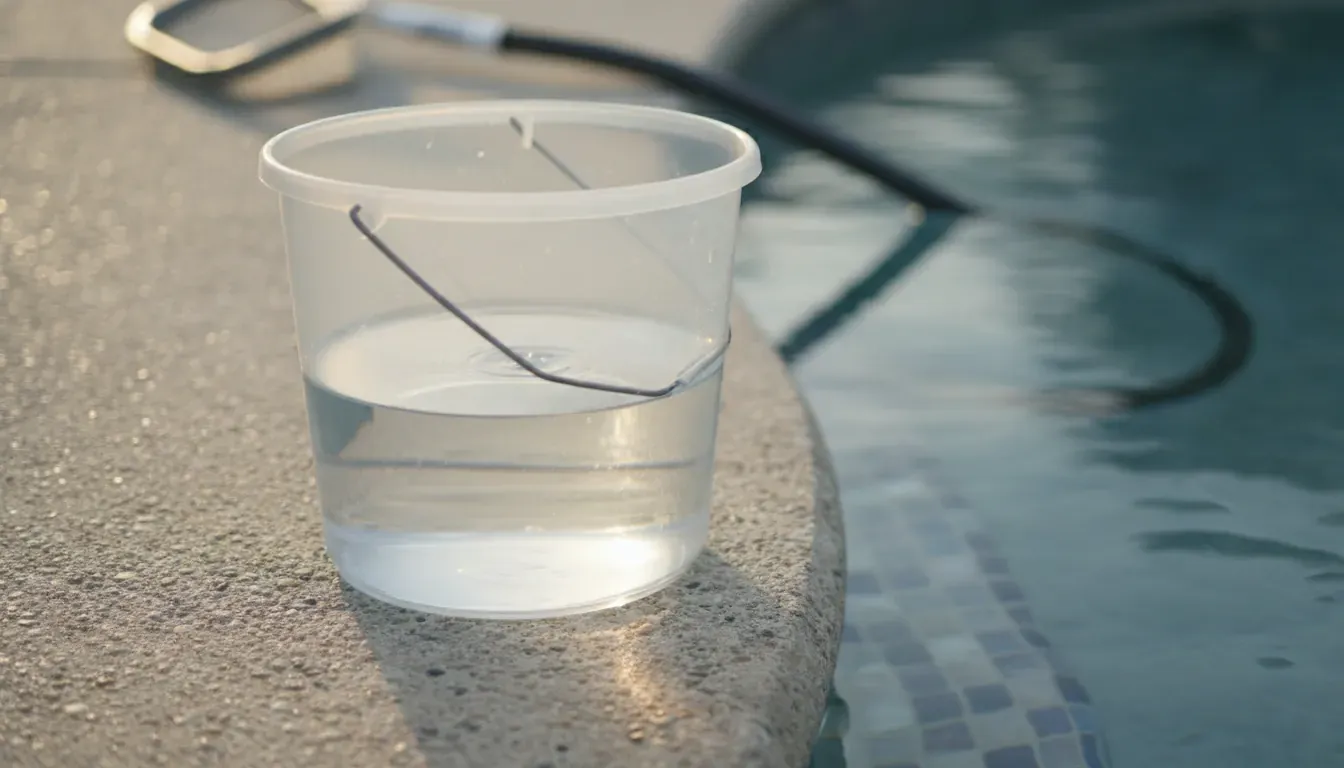
- Set up a bucket comparison. Place a stable bucket on a pool step, with the bucket water near the pool water level. Mark both water levels. Keep the bucket secure and away from swimmers.
- Compare after a set period. After a day or two, compare the drop in the pool with the drop in the bucket. The bucket provides a rough evaporation comparison because both are exposed to similar weather.
- Repeat if conditions changed. Wind, temperature, sun, and pool use can vary. A repeat under steadier conditions can make the comparison more useful.
This screening test does not prove that a leak exists or identify its location. City of Mesa's pool bucket test guidance describes comparing pool and bucket water levels to help distinguish evaporation from a possible leak: City of Mesa: Pool Water Loss. Treat any difference as a reason to investigate further, especially if the pool continues to drop when it is not being used.
What common causes should you check first?
| Possible cause. | Clues to look for. | Practical next step. |
|---|---|---|
| Evaporation. | Gradual change during dry, sunny, or windy weather; no clear wet area. | Compare pool loss with a bucket test and record the weather. |
| Swimming or splash-out. | Loss follows busy use, play, or water features. | Compare a quiet period with normal use. |
| Filter backwashing or draining. | Water drops after maintenance or a filter cycle. | Check whether water was discharged and when. |
| Skimmer, return, or light fitting. | Loss may be greater at a particular level; no surface puddle required. | Observe whether the level stabilizes near a fitting and arrange an inspection. |
| Underground plumbing or concealed shell leak. | Persistent loss that does not track with weather or use. | Keep a log and request professional leak diagnosis. |
| Overflow or automatic fill issue. | Water movement near an overflow, or an unexpectedly active fill system. | Check the visible overflow and monitor the fill system safely. |
These clues narrow the possibilities; they are not definitive tests. Avoid dismantling equipment or digging around a suspected pipe based only on a water-level change. A qualified technician can assess the system and choose appropriate diagnostic steps. If the issue appears related to circulation or filtration equipment, Neptune Pools describes its pool equipment repair and servicing options.
What can pool losing water but no visible leak reveal?
When a pool is losing water but no visible leak appears, the pattern of loss can provide a useful screening clue. It cannot, by itself, identify a failed pipe, fitting, liner, or shell. Start by recording the water level at the same reference point and noting weather, swimming, backwashing, water features, and any automatic refill activity.
A stopping point can narrow the possibilities
If the water level drops and then stabilizes, that stopping point may be near a fitting. Light niche, skimmer, or another part of the pool where a leak changes as the water falls. A stable level does not prove the source, however. Evaporation, splash-out, or a changing operating condition can create a similar pattern. Look for wet ground, air bubbles, or water appearing near the landscape, but do not treat the absence of those signs as proof that no leak exists.
Use the bucket comparison as a screen
A weighted bucket placed on a pool step can help compare pool loss with weather-related loss. Mark the water level in both the bucket and pool, keep the bucket secure, and compare them after two or three days. The City of Mesa recommends this approach and advises turning off an automatic autofill valve during the test: City of Mesa pool leak guidance. If the pool drops more than the bucket, that is a reason to investigate further, not a confirmed diagnosis.
Pump-on and pump-off observations add context
Repeating the comparison with the pump running and then turned off may show whether water loss changes with the circulation system operating. Greater loss while the pump runs can suggest a plumbing-related issue, while similar results in both conditions point to the need for broader evaluation. Do not open pressurized equipment, disconnect plumbing, or run a pump below its safe water level. A qualified technician can interpret the pattern alongside equipment condition, operating history, and site evidence.
How can Denver weather affect the result?
Colorado conditions can make water-level changes harder to interpret. Dry air, sunshine, elevation, and wind can all influence evaporation, while a sudden weather shift can change the rate from one day to another. These are factors, not a fixed local evaporation rate. Do not treat a calculated estimate as proof that all observed loss is evaporation.
Pool use and water features also matter. Swimmers carry water out, play can splash water over the edge, and fountains or spillovers expose more water to moving air. A pool cover that is appropriate for the pool and used correctly may reduce evaporation, but it does not repair a leak. Keep safety requirements in mind when using or securing a cover.
Seasonal operation adds another reason to keep good records. Before changing water levels or equipment settings as temperatures fall, consider the pool's operating instructions and the local freeze risk. Winter water levels and freeze-protection decisions are separate from a leak test; do not lower the pool based on a general rule. Neptune Pools offers information on pool closing and winterization in Denver.
When should you call for professional help?
Contact a pool professional when the loss is persistent, appears to accelerate, continues during a quiet period, or cannot be explained by the bucket comparison and recent use. Also seek help if water is near the minimum operating level, the pump is taking in air. Equipment is behaving differently, or water is emerging near the deck or equipment pad.
Before the visit, gather useful details:
- Dates, times, and water-level readings, including pool and bucket marks.
- Recent weather, rain, swimming, water-feature use, and maintenance events.
- Whether the pump was running during each observation and any changes in pressure or operation.
- Photos of the waterline, equipment area, and any damp ground or unusual discharge.
- Any recent work on the pool, plumbing, filter, or automatic fill system.
This record helps distinguish a repeatable pattern from a one-time change. If you need ongoing care while the issue is assessed, review Neptune Pools' pool cleaning and maintenance information. Service needs vary by pool and condition, so ask what inspection or repair steps are appropriate rather than assuming a particular fix.
What should you avoid doing?
- Do not assume every drop is a leak. Check water use, maintenance, weather, and the bucket comparison first.
- Do not ignore a continuing decline. Persistent loss can waste water and may affect equipment if the level falls too far.
- Do not add chemicals to compensate for unexplained loss. Test and balance water according to the pool's needs; chemical adjustment does not repair a leak.
- Do not make major plumbing or shell repairs based on guesswork. Locating the source first can prevent unnecessary work.
- Do not use winterization water-level rules as a leak-detection method. Freeze protection depends on the pool and equipment and should be handled separately.
There is also a useful way to estimate the volume of observed water loss without mistaking it for a diagnosis. Measure the pool's approximate surface area in square feet and the depth change in inches. Multiply surface area by depth loss, divide by 12 to convert inches to feet, then multiply by 7.48052 to estimate gallons lost over the measurement period. Divide that amount by the number of test days for an approximate daily net loss. For example, a 500-square-foot surface with a half-inch drop over two days yields about 156 gallons total, or roughly 78 gallons per day. This is an estimate of net loss; it does not separate evaporation, splash-out, discharge, or leakage. Irregular pool shapes and uneven waterlines also make the result approximate.
For this calculation, use the pool's water surface area, not the deck footprint. A rectangular pool is straightforward: multiply length by width. For an oval or freeform pool, use a reasonable approximation and note the uncertainty. Repeat the test at the same reference point after conditions stabilize. If you add water during the interval, record the amount or restart the test; otherwise the measured drop understates the water that left the pool.
Discuss persistent pool water loss with Neptune Pools equipment repair and servicing.
How can you improve the test and interpret the results?
A useful water-loss record separates what you observed from what you suspect. Make a simple table in a notebook or phone with the date, start and end level, weather, pool activity, pump status, and any water added or discharged. Write down the measurement unit and use the same marked reference each time. If one reading seems unusual, repeat it rather than treating it as a trend.
Choose a test window with as few changing factors as practical. Avoid comparing a quiet weekday with a weekend full of swimming, or a dry interval with one that includes rain. If a water feature normally runs, note its schedule; if you temporarily pause it, record that change and make sure doing so is safe for the equipment. Do not leave the pool unattended or alter normal circulation in a way that could harm the system.
When reading the bucket comparison, compare the amount the pool dropped with the amount the bucket dropped over the same interval. If both fall by a similar amount, weather-related evaporation may explain much of the change, but use and measurement uncertainty remain possible. If the pool falls noticeably more, that difference is a screening clue, not a measured leak rate. Splash-out, backwashing, overflow, and other water losses can affect the pool but not the bucket.
For example, suppose the pool mark falls three-quarters of an inch while the bucket falls one-quarter inch over the same period. The pool's additional observed drop deserves follow-up, particularly if the result repeats during a low-use interval. It still does not show whether the source is a fitting, shell, line, or discharge path. Share the notes and photos with a pool professional rather than translating that difference into a repair diagnosis.
Before repeating a test, confirm that the bucket stayed stable and was not disturbed. That readings were taken from the same point, and that no one topped up the pool. Wind can move water and make a small difference harder to read; take care to note rough conditions. A short test may be obscured by ordinary variation, while a longer one can include more weather and pool-use changes. Choose a practical interval, document what happened, and repeat under comparable conditions when the pattern is unclear.
What can a pool cover change?
A properly fitted and correctly used pool cover can reduce the amount of water exposed to air and may limit evaporation when the pool is not in use. Its effect depends on the cover, fit, use, weather, and pool configuration. A cover is not a leak repair and cannot explain away water loss that continues beyond what the comparison suggests.
Use the cover according to its instructions and the pool's safety needs. Do not treat a cover as a substitute for barriers, supervision, or other required protections. If you compare covered and uncovered periods, record the change in conditions; do not assume the difference isolates evaporation perfectly, because weather and pool activity may also change.
For a fair comparison, note when the cover was installed or removed, whether it covered the full water surface, and whether the pool was used during either interval. If a cover is damaged or does not fit, avoid drawing conclusions from that trial. The practical question remains whether unexplained loss persists after accounting for weather, use, and water discharged from the system.
How should you decide what to do next?
- Record the pattern before changing anything. Note the pool level, date, weather, recent swimming, water features, rain, and any filter cleaning or backwashing. Use the same reference point and check at similar times. A measured net loss is useful evidence, but it is not proof of evaporation or a leak.
- Screen the conditions with a controlled comparison. A weighted bucket on the top step can help compare pool loss with evaporation. Mark the pool and bucket levels, keep the bucket secure, and compare after two to three days. City of Mesa guidance also recommends considering separate pump-on and pump-off comparisons when appropriate. Repeat the test if wind, temperature, or pool use changed significantly. Read the Denver pool leak detection guide for the broader screening process.
- Protect the equipment while you investigate. Do not let the water fall below the level needed for safe circulation, and do not run equipment dry. Avoid digging, opening pressurized equipment, or removing fittings based only on a water-level change. If an automatic fill system is active, record that fact rather than assuming it has solved the problem. Keep freeze-protection and winter water-level decisions separate from leak testing, because seasonal procedures depend on the pool and equipment.
- Escalate when the pattern persists. Continued loss during a quiet period, a pool-to-bucket difference, or loss that follows a particular equipment cycle warrants a professional assessment. Hidden plumbing, fitting, liner, or equipment-related losses may not create a visible puddle. Share your level log and test conditions so the technician can choose the next diagnostic step without guessing.
Neptune Pools can also help evaluate circulation and filtration equipment, including pumps, filters, heaters, and automation, when the symptoms point in that direction.
Frequently Asked Questions
How much water loss is normal for a pool?
There is no single amount that applies to every pool and every day. Weather, pool size, wind, sun, use, and water features change the result. Compare measured loss with a bucket under similar conditions, then repeat if the weather or use changes.
Can a pool leak underground without leaving a wet spot?
Yes. Water from a buried line or concealed area may disperse into soil or drain away without forming a visible puddle. A lack of wet ground does not rule out a leak, so a consistent unexplained decline merits further assessment.
Should I turn off the pump to see whether the pool stops losing water?
Do not leave equipment off or on in a way that risks damage or unsafe water conditions. Pump-off comparisons can be misread and may not identify the source. Ask a pool professional how to conduct any equipment-specific test safely.
Can wind and dry air make the water level fall faster?
They can contribute to evaporation, along with sunlight and temperature. The effect varies with conditions, so use a contemporaneous bucket comparison rather than relying on a fixed Denver rate.
What information should I have ready when I contact a pool professional?
Share dated water-level readings, bucket-test results, recent pool use and maintenance, weather conditions, and any equipment changes or damp areas. Clear observations help focus the next step.
A careful record and a simple controlled comparison can help separate weather-related changes from a problem that needs inspection. If the pool keeps losing water or the equipment level is at risk, arrange a professional assessment rather than waiting for a visible leak to appear.
Related Blogs