Salt Water Pool Chemistry Guide for Denver Pool Owners
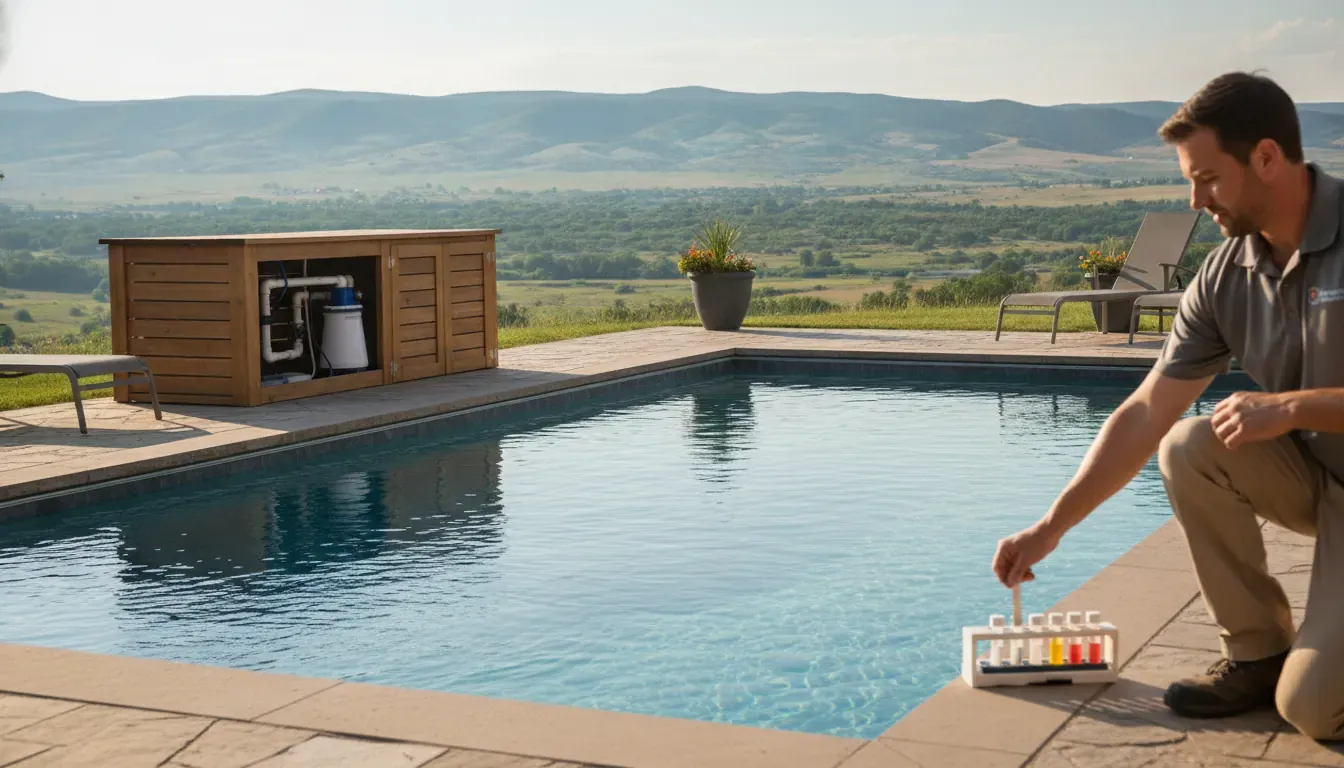
A salt system can make chlorine on site. It does not make pool care automatic. In Denver, strong sun, dry air, and hard Front Range water can shift readings as the season changes. Regular testing protects swimmer comfort and helps prevent unnecessary strain on the generator and other equipment.
Explore pool cleaning and maintenance plans.
Salt water pool chemistry depends on more than the salt reading: a properly adjusted generator, free chlorine, pH, alkalinity, CYA, and calcium hardness all work together. Most salt chlorine generators operate around 2,500-4,000 ppm salt, while CYA for a salt pool is commonly targeted at 30-50 ppm. Your equipment manual remains the final authority for operating ranges.
Understanding what happens inside the salt cell makes the rest of the testing routine easier to manage. It also explains why a pool can have an active generator and still need thoughtful adjustments to stay clear, comfortable, and ready for use.
How Salt Water Pool Chemistry Creates Chlorine
A salt pool does not replace chlorine with salt. Instead, it uses a salt chlorine generator to produce chlorine from salt already dissolved in the water. That process can make chlorine delivery more consistent, but it does not make water chemistry automatic. The generator still depends on the right salt concentration, water flow, and balanced supporting readings.
Dissolved salt becomes chlorine inside the cell
After pool-grade salt dissolves, the pool water passes through an electrolytic cell installed in the circulation system. The cell applies an electrical current to the saltwater. This process, called electrolysis, converts dissolved salt into chlorine that sanitizes the water. The chlorine then performs its normal job, helping control germs and organic contamination, while the salt is converted back through the water chemistry cycle.
Most salt chlorine generators operate efficiently with salt levels between 2,500 and 4,000 parts per million (ppm), although the correct setting belongs to the specific generator model. Salt can leave the pool through splash-out, leaks, and water removal, so a low-salt warning should be confirmed with a test rather than corrected by guesswork. If salt is added during startup or after a water replacement, it should be fully dissolved before the generator is turned on. Undissolved salt can damage the cell plates.
Electrolysis produces chlorine, not a maintenance-free pool
The generator controls one part of the sanitation system. It does not independently balance pH, alkalinity, stabilizer, or calcium hardness. Neptune Pools recommends thinking of salt water pool chemistry as a connected system, where each reading affects equipment performance and swimmer comfort.
Electrolysis can gradually raise pH, so pH needs regular attention. Total alkalinity acts as a buffer that helps reduce rapid pH swings. Cyanuric acid, also called CYA or stabilizer, helps protect outdoor chlorine from sunlight. For salt pools, the Neptune Pools operating target for CYA is 30 to 50 ppm. Calcium hardness also matters, especially in concrete pools, where the target is 200 to 400 ppm.
Why testing still matters in Denver
Chlorine and pH are the first defense against germs in pool water, according to the CDC. Its residential pool guidance places pH at 7.0 to 7.8. Denver conditions make consistent testing especially important. Evaporation can concentrate chemicals and increase total dissolved solids, while strong high-altitude sunlight can accelerate chemical breakdown. A salt generator can keep producing chlorine while other readings drift outside their operating targets. Testing is how you identify that drift before it affects sanitation, surfaces, or the salt cell.
Which Salt Water Pool Chemistry Levels Should You Test?
A salt chlorine generator does not make water maintenance automatic. It produces chlorine from dissolved salt, but the pool still needs regular testing to keep sanitizer performance, swimmer comfort, and equipment condition on track. Test the core readings together rather than reacting to a single number. A salt reading can be acceptable while pH is drifting, or chlorine can appear low because the generator output, water temperature, or stabilizer level needs attention.
The six readings that matter most
The ranges below are typical operating targets, not universal guarantees. Always compare them with the salt-cell manufacturer's instructions, the pool surface, and guidance for the specific test kit or controller. For a general foundation, the salt water pool chemistry guide can help you understand how the readings interact.
| Reading | Typical target | What it tells you |
|---|---|---|
| Salt | 2,500-4,000 ppm | Whether the generator has enough dissolved salt to produce chlorine efficiently. |
| Free chlorine | Follow the generator and pool-specific recommendation | How much active sanitizer is available to control germs and organic contamination. |
| pH | 7.0-7.8 for residential pools | Water balance, swimmer comfort, pipe protection, and chlorine effectiveness. |
| Total alkalinity | Use the pool-specific system recommendation | How well the water resists rapid pH swings. |
| Cyanuric acid (CYA) | 30-50 ppm for salt pools | How effectively stabilizer protects outdoor chlorine from sunlight. |
| Calcium hardness | 200-400 ppm for concrete pools | Whether the water may be aggressive toward concrete surfaces or prone to scale. |
How to interpret the results together
Salt is the raw material for the generator, while free chlorine is the result that protects the water. Salt concentration should be tested regularly because salt leaves the pool through splash-out, leaks, and backwashing. Add only high-purity pool-grade salt, and allow it to dissolve fully before activating the cell.
pH and alkalinity work as a pair. Total alkalinity buffers pH changes, while electrolysis can gradually push pH upward over time. The Centers for Disease Control and Prevention identifies chlorine and pH as the first defense against germs in pools and recommends a residential pH range of 7.0-7.8. Water above that range can reduce chlorine effectiveness, while water below it can increase corrosion risk. Adjusting alkalinity first may make later pH corrections more stable.
Readings that need closer attention in Denver
CYA protects chlorine from Denver's intense outdoor sunlight, but it should not be increased casually. Neptune Pools uses 30-50 ppm as a salt-pool target to balance chlorine stability and effectiveness. Calcium hardness also deserves attention after a startup, drain, or major water replacement because Denver's Front Range water is hard, commonly measured at about 8-12 grains. Concrete pools typically need 200-400 ppm to help protect surfaces. Evaporation can concentrate dissolved chemicals and increase total dissolved solids. So unusual results or repeated balancing problems are a reason to test more often and evaluate the water as a whole.
Why Denver Conditions Change Salt Pool Chemistry
Denver's elevation and dry climate change how quickly a salt pool moves out of balance. The salt chlorine generator still performs the same basic job, but the water around it is exposed to stronger sun, faster evaporation, and local source-water characteristics. Those factors make a consistent testing and adjustment plan more important than relying on the generator's status light alone.
Evaporation concentrates the water
Dry air and warm, sunny conditions remove water from the pool while dissolved materials remain behind. As evaporation continues, salt and other chemicals become more concentrated. Total dissolved solids, or TDS, can also rise. High TDS may make the rest of the water chemistry harder to adjust, so adding more chemicals is not always the right answer. A partial water replacement may eventually be more appropriate, depending on the test results and the pool's overall condition.
Evaporation does not remove the salt in the same way that it removes water. When you add make-up water, the salt concentration can change in the opposite direction. Test before correcting the reading, and do not add salt simply because the pool level was low. Most salt generators operate efficiently between 2,500 and 4,000 parts per million, but the equipment manufacturer's recommended range should take priority.
High-altitude sun affects chlorine demand
Intense high-altitude sunlight can accelerate the breakdown of pool chemicals, including chlorine. Cyanuric acid, commonly called CYA or stabilizer, helps protect outdoor chlorine from sunlight. Neptune Pools generally targets 30 to 50 ppm of CYA for salt pools, balancing chlorine stability with effective sanitation. CYA is not a substitute for testing free chlorine and pH. Chlorine and pH remain the first defense against germs, and the CDC identifies 7.0 to 7.8 as the residential pool pH range.
Denver source water can affect calcium
Denver's Front Range water is hard, commonly measured at about 8-12 grains, so calcium and scale deserve attention after a pool startup, drain, or substantial water replacement. High calcium and rising pH can contribute to scale on surfaces and salt-cell plates. For concrete pools, a 200 to 400 ppm calcium hardness target helps protect those surfaces, but test the pool before making an adjustment. Test the fill water and the pool water before adding a calcium increaser, since the correct adjustment depends on the pool surface and current readings.
For a deeper explanation of local conditions, review Colorado salt water pool chemistry. The practical goal is not to chase every number independently. Read the full set of results, account for recent evaporation or added water, then make measured corrections that protect both swimmer comfort and the salt cell.
Get help with salt-cell equipment repair.
How Do You Adjust a Salt Pool Through Colorado Seasons?
Colorado's pool season is shaped by sharp temperature changes, intense sun, evaporation, and freezing weather. A salt chlorine generator does not remove the need for testing. It changes how chlorine is produced, while pH, alkalinity, stabilizer, salt, and water temperature still need attention. Use the following sequence as an operating guide, then confirm the exact settings and winterization steps for your generator and pool equipment.
- Open the pool and establish a baseline. After removing the cover and starting circulation, test salt, free chlorine, pH, total alkalinity, cyanuric acid (CYA), and calcium hardness. Denver's Front Range water is hard, commonly measured at about 8-12 grains, so calcium and scale deserve attention after a drain or major water replacement. For most salt generators, the operating salt range is approximately 2,500 to 4,000 ppm, but the equipment manufacturer's specification controls. Add only high-purity pool-grade salt, and let it dissolve completely before activating the salt cell.
- Set up warm-season operation. Once the water is balanced and the pump is circulating properly. Enable the generator and adjust its output according to chlorine testing, bather load, water temperature, and the manufacturer's guidance. Colorado's high-altitude sun can accelerate chemical breakdown, while evaporation can concentrate dissolved chemicals and raise total dissolved solids. Test more often when the weather is hot, the pool is heavily used, or water is being added. Keep CYA within the salt-pool target of 30 to 50 ppm, and remember that electrolysis can gradually raise pH, making regular pH and alkalinity adjustments necessary.
- Respond to colder water near 60 F. Many salt cells have an automatic low-temperature cutoff around 60 F to protect the cell. If chlorine production stops as the water cools, do not assume the generator is broken or force it to operate outside its design range. Follow the equipment manual for temporary chlorination and circulation, and continue testing so the sanitizer does not fall below the appropriate operating level.
- Close before sustained freezing weather. Lower the water and winterize plumbing, filters, pumps, and other equipment according to the pool's design and the manufacturer's instructions. Freeze protection may require draining lines and using approved winterization procedures. Do not rely on a salt system alone to protect water-filled equipment during a Colorado freeze.
- Remove and store the salt cell indoors. Take out the cell before winter storage, inspect it for scale, and keep it indoors where freezing temperatures cannot crack the housing or damage internal components. If the cell, plumbing, or controls do not drain as expected, stop and have a qualified technician handle the winterization rather than guessing at a valve sequence.
For a broader local reference, review Neptune Pools' Colorado salt water pool chemistry guide.
Salt Cell Maintenance and Repair Warning Signs
The salt cell is the working point where the generator uses electrolysis to produce chlorine. Keeping it clean and operating within the system's specifications protects both chlorine output and the broader balance of your pool. Salt water pool chemistry still depends on regular testing, because a generator cannot correct every issue caused by changing water conditions.
Inspect for scale before it restricts chlorine production
Inspect the salt cell about every three months for calcium scale deposits. Scale can accumulate on the cell plates and interfere with the electrolysis process. If buildup is present, a mild acid cleaning solution may be appropriate, but cleaning is not automatically better. Follow the cell manufacturer's procedure, use the correct solution and protective equipment, and avoid scraping the plates or soaking the cell longer than directed. Aggressive or overly frequent cleaning can damage the coating that allows the cell to generate chlorine.
Balanced water helps reduce unnecessary scale. Pay particular attention to calcium hardness and pH, since persistent imbalance can place additional stress on equipment. In Denver, local water conditions and evaporation can change the concentration of dissolved minerals. So a cell that looks clean at one inspection should not be assumed to stay that way all season.
Low output and alarms deserve a diagnosis
A low-chlorine reading or a salt-system alarm does not always mean the cell itself has failed. Check the basics first: confirm the actual salt concentration with a reliable test, verify water flow, and review pH and stabilizer levels. Most salt chlorine generators operate efficiently within a model-specific range, commonly about 2,500 to 4,000 ppm. A generator may also stop producing chlorine when water temperature falls below roughly 60 F, which is a protective cutoff rather than proof of a defective cell.
If chlorine remains low after the water is balanced and the equipment has adequate flow. Or if alarms return after resetting the system, have a certified technician test the cell and related components. Neptune Pools can evaluate salt-cell equipment repair needs instead of replacing parts based on an error message alone.
Know when the cell is reaching the end of its service life
A salt cell is a wear component, not a lifetime part. With proper care, cells commonly last about 3 to 7 years, but water chemistry, operating hours, cleaning practices, and seasonal use all affect that range. Repeated low-output warnings, declining chlorine production despite correct settings, visible plate damage, or a cell that fails testing can indicate replacement is warranted. In Colorado, remove and store the cell indoors during winterization to help prevent freeze damage. A technician can distinguish routine maintenance from an exhausted cell and confirm that the generator, flow sensor, and control settings are working together before recommending the next repair.
Can Salt Water Pools Stay Balanced With Less Daily Work?
Yes, but "less daily work" should mean fewer manual chlorine additions, not a hands-off pool. A salt chlorine generator converts dissolved salt into chlorine through electrolysis, helping maintain a steadier chlorine supply. The water still needs testing, adjustment, and observation. The goal is a routine that catches small changes before they become swimmer-comfort, surface, or equipment problems.
Build a simple testing routine
Check the readings that guide the generator and the rest of the system: free chlorine, pH, total alkalinity, salt concentration, and, at appropriate intervals, CYA and calcium hardness. Total alkalinity helps buffer pH changes, while electrolysis can gradually push pH upward. That combination makes pH and alkalinity especially important in everyday pool cleaning and maintenance plans.
Salt does not disappear through chlorine production, but it can be lost through splash-out, leaks, and water removal. Test the concentration rather than adding salt by guesswork. Most generators operate efficiently within a manufacturer-defined range, and many systems commonly target 2,500 to 4,000 ppm. Always follow the installed equipment's specifications, and make sure newly added salt has dissolved completely before activating the cell.
Look beyond the test kit
A quick visual inspection is part of the chemistry routine. Look for cloudy water, scale, unusual staining, low-flow conditions, or a generator alarm. Check water level and confirm circulation is normal. In Denver, evaporation can concentrate chemicals and increase total dissolved solids, while high-altitude sun can accelerate chemical breakdown. Those conditions are reasons to test more attentively when weather, water level, or swimmer load changes, not reasons to rely on a fixed calendar.
Document changes and prevent repeat problems
Keep a short log of test results, water additions, chemical adjustments, alarms, and cell inspections. A pattern of rising pH, falling salt, or recurring low output is easier to diagnose from a record. Inspect the salt cell for scale about every three months, and use the manufacturer's cleaning procedure when buildup is present. If the system continues to alarm, produces weak chlorine despite balanced readings, or shows visible damage. Stop treating it as a routine adjustment and have a qualified technician evaluate the equipment.
Schedule professional pool cleaning and maintenance.
Frequently Asked Questions About Salt Water Pool Chemistry
Do I still need chlorine in a salt water pool?
Yes. A salt chlorine generator makes chlorine from dissolved salt through electrolysis, but chlorine remains the sanitizer that helps control germs. You still need to test free chlorine, pH, and alkalinity, then adjust the water when readings move outside your operating targets. The generator reduces manual chlorine dosing; it does not replace routine water testing.
What is the ideal salt level for a salt water pool?
Most salt chlorine generators operate efficiently between 2,500 and 4,000 parts per million, but the equipment manufacturer's specification should take priority. Test before adding salt, use only high-purity pool-grade salt, and allow it to dissolve completely before turning on the cell. Salt can leave the water through splash-out, leaks, or backwashing, so do not rely only on the generator's display. Neptune Pools recommends checking salt concentration regularly. Review the pool supplies and chemical resources for testing help and professional-grade products.
What is the role of CYA in salt water pool chemistry?
Cyanuric acid, or CYA, helps protect outdoor chlorine from being consumed by sunlight. Neptune Pools' operating target for salt pools is 30 to 50 ppm, which supports chlorine stability without excessive stabilizer buildup. Check CYA as part of your broader chemistry routine, especially after adding water or making a seasonal adjustment.
How often should I clean my salt cell?
Inspect the salt cell about every three months for calcium scale. If buildup is present, cleaning with a mild acid solution may be necessary, following the cell manufacturer's instructions. Do not scrape the plates or clean a cell that is still connected to power. Persistent scale, low chlorine output, or repeated alarms can indicate a chemistry or equipment problem that needs technician diagnosis.
How should I handle salt water pool chemistry in a Colorado winter?
As water cools, chlorine production may stop automatically at around 60 degrees Fahrenheit. Before freezing weather, follow the equipment manufacturer's winterization procedure, remove the salt cell, and store it indoors to help prevent freeze damage. When reopening, test the water before restarting the generator, and account for Denver evaporation and high-altitude sunlight as the season progresses.
Ready to Get Help With Your Salt Water Pool?
Denver conditions can make salt water pool chemistry more demanding, especially when seasonal changes affect water balance or salt-cell performance. Neptune Pools can help you sort out the next practical step for maintenance, testing, or equipment concerns.
Related Blogs